Get Full Government Meeting Transcripts, Videos, & Alerts Forever!
Get email alerts on the Nuisance Property topic
No spam. Unsubscribe anytime.
Committee advances expanded chronic-nuisance ordinance to include certain off-site activity, new offenses and cost recovery
Summary
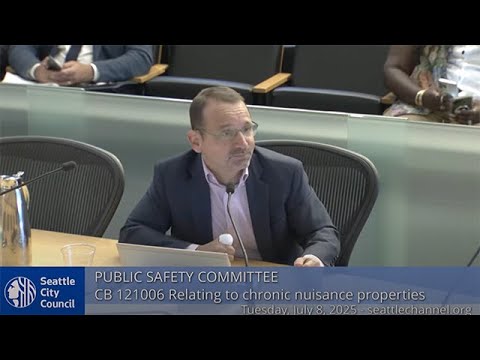
The Public Safety Committee voted July 8 to recommend passage of CB 121006, updating Seattle's chronic-nuisance rules to allow certain off-property activity and new categories of conduct to count as evidence of a nuisance property.
The Seattle Public Safety Committee on July 8 recommended passage of Council Bill 121006, an ordinance revising chronic-nuisance property rules to allow certain off-property activity to count toward a property being designated a chronic nuisance. The committee adopted six amendments that clarify findings, update penalty levels for inflation, expand the list of nuisance activities, clarify cost-recovery authority, require the City Attorney to consider disputing documentation, and tighten the standard for linking off-site activity to a property.
The clerk read CB 121006 into the record; Director Noble (central staff) and Vice Chair Alex Saka guided the committee through technical and policy changes. The committee adopted Amendment 1B to add two findings emphasizing that nuisance activity in residential zones is part of the problem the ordinance addresses (adopted 4-0).
Amendment 2 raises maximum fines by approximately 50% to reflect inflation since the original 2009 code; central staff described the change as aligning maximum penalties with present-day values. The committee adopted Amendment 2 by recorded vote (three yes, one abstention).
Amendment 3 expanded the list of activities that can count as evidence of a nuisance property to include possession or trafficking in stolen goods, cruelty-to-animals violations, garbage/waste/health-code violations (including rodent control), and noise-code violations. Director Noble and the sponsor pointed to peer-city practices. Members debated enforcement discretion, cross-departmental documentation (for example, SDCI, Seattle Public Utilities, and King County Public Health), and the risk of unintended consequences; the amendment passed with two yes votes and two abstentions.
Amendment 4B clarified that unpaid abatement costs the city incurs may be recovered by a lien on the property; central staff said this is a clarification of existing authority (adopted 4-0).
Amendment 5 adds an explicit due-process step: before the City Attorney initiates court action the office must consider documentation provided by the person in charge or property owner contesting a chronic-nuisance designation. Director Noble said the City Attorney's office already considers such information; the amendment makes that explicit. The committee adopted Amendment 5 unanimously.
Amendment 6 tightened the connection required between off-site activity and a property by requiring the city to show a clear nexus (for example, proximity/adjacency, involvement of a person associated with the property, and factual circumstances establishing the connection). Central staff described "clear nexus" as a higher evidentiary expectation than a general nexus, designed to limit overbroad use of off-site findings. The amendment was adopted unanimously.
Committee members acknowledged both the need for tools to address properties that pose public-safety risks and concerns about administrative discretion, cross-agency coordination, and effects on property and small-business owners. Several members asked for ongoing oversight or clarification to ensure the new definitions are applied to cases with public-safety implications and not used inappropriately against property owners who are victims of dumping or neighboring construction impacts.
The committee recorded a final vote recommending the bill as amended; it will be transmitted to the July 15 full Council meeting for consideration.