Get Full Government Meeting Transcripts, Videos, & Alerts Forever!
Get email alerts on the Task Force Overview topic
No spam. Unsubscribe anytime.
Legislative task force gathers experts and parents to weigh enforcement and false-report remedies in custody disputes
Summary
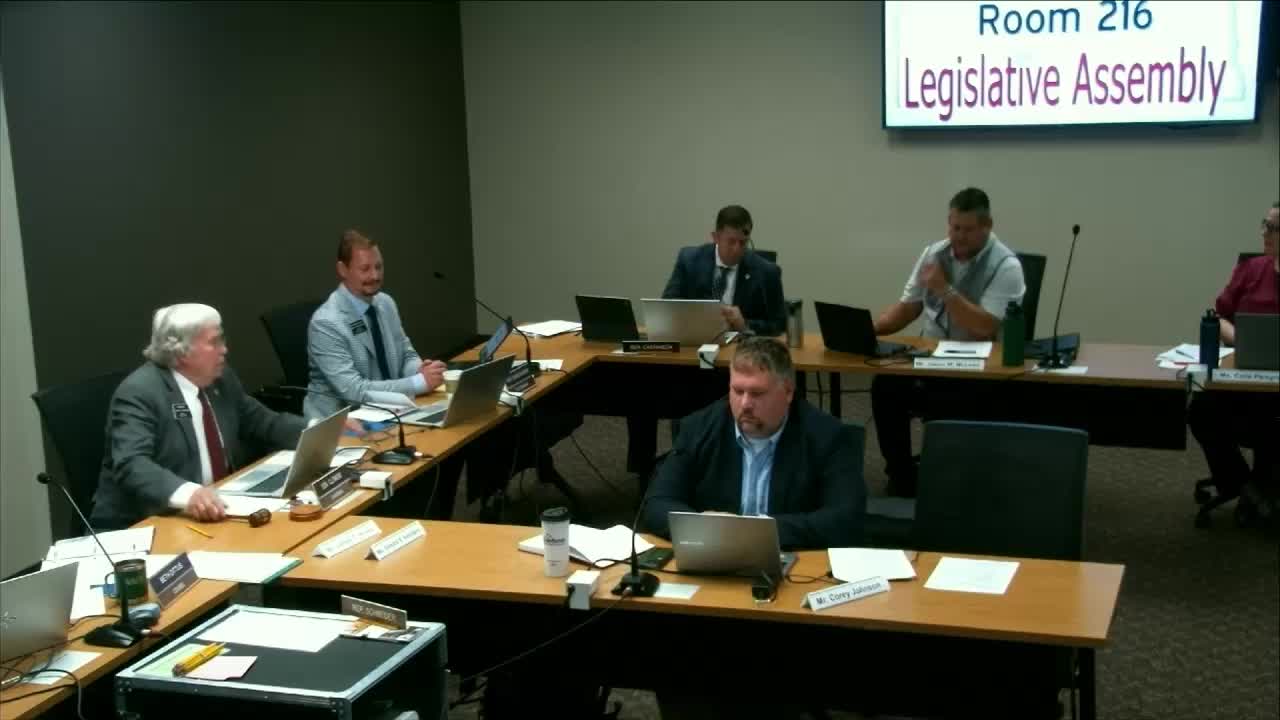
Chairman Dave Clemens called the Child Custody Review Task Force to order, urging members to place truth at the center of their work: "Without truth, there's no justice."
Chairman Dave Clemens called the Child Custody Review Task Force to order, saying the group was created to find practical ways to enforce custody orders and address false allegations in custody proceedings. "Without truth, there's no justice," Clemens said as he opened the meeting.
The task force spent the morning on staff briefings from legislative counsel Beth Dittis, who walked members through the background memorandum and the legislative history of Senate Bills 2186 and 2184 — the measures that led the Legislative Management to create the task force. Dittis said the task force must recommend approaches to (1) address withholding of a child in violation of a custody decree, (2) consider remedies for false reporting in custody contexts, and (3) review possible expedited forms, self-help tools and automated assistance. She noted the committee’s final report is due to the legislative management in June 2026.
Members then heard a series of presentations outlining the practical constraints that shape enforcement. Supreme Court Self-Help Center director Katie Palsgraf described internet-accessible forms and guides and said the center sees about 1,500 contacts a year; she told the task force the center lacks a general-use contempt form set because contempt hearings are highly fact-specific, though targeted form sets focused on parenting-time enforcement might be feasible.
Law enforcement officials argued against creating criminal sanctions that are hard to apply on patrol and could increase trauma to children and risk to officers. Sergeant Trent Stanton of the West Fargo Police Department told the committee officers often serve as mediators in volatile situations and must make rapid safety decisions with limited information. He warned that on-the-spot arrests to enforce disputed custody provisions could escalate violence or traumatize children rather than protect them.
Kirsten Hansen, prevention and protection administrator for the Department of Health and Human Services, explained the limits of the child-protection system: CPS conducts assessments when there are credible allegations of abuse or neglect, with immediate responses for present danger and three-day responses for impending danger. She said CPS does not exist to resolve ordinary custody disputes and that willfully false reports are referred to law enforcement, but are rare in CPS practice.
Multiple parents and family-law practitioners testified about long-running litigation, the cost of supervised visitation and mental-health evaluations, and the emotional toll on children. David Kawasaki, a disabled veteran, said years of contested filings and claims he calls unfounded have reduced his parenting time to supervised four-hour visits and left him with substantial legal and enforcement costs. Lucy Bauer and other parents described long absences from children's daily life and said they had endured health problems tied to stress.
Members asked staff to return with focused research: (1) models for expedited civil procedures and designated family-court calendars used in other states, (2) data on mediation outcomes and time-to-hearing, and (3) an inventory of statutory provisions and court rules (including Rules of Court governing mediation and judicial referees) relevant to parenting-time enforcement. The task force scheduled its next meeting for December 10, 2025 (subject to room availability) and directed staff to prepare a memorandum comparing family-court and referee-based models and to collect sample expedited-enforcement procedures from other states.
The discussion reflected a tension that threaded the day: members supported stronger remedies for parents who lose court-ordered time or who are targeted by false allegations, but presenters cautioned that remedies must be narrowly drawn and implementable without creating unintended harms to children or front-line responders.
Looking ahead, Dittis said, the committee will evaluate options ranging from improved forms and mediation triage to specialized calendars or dedicated family-court tracks, with an eye to statutory language that produces clear, enforceable standards for officers, courts and parties.