
SJC hears arguments on whether juvenile DYS confinement must count as credit against later adult sentence
Get AI-powered insights, summaries, and transcripts
Subscribe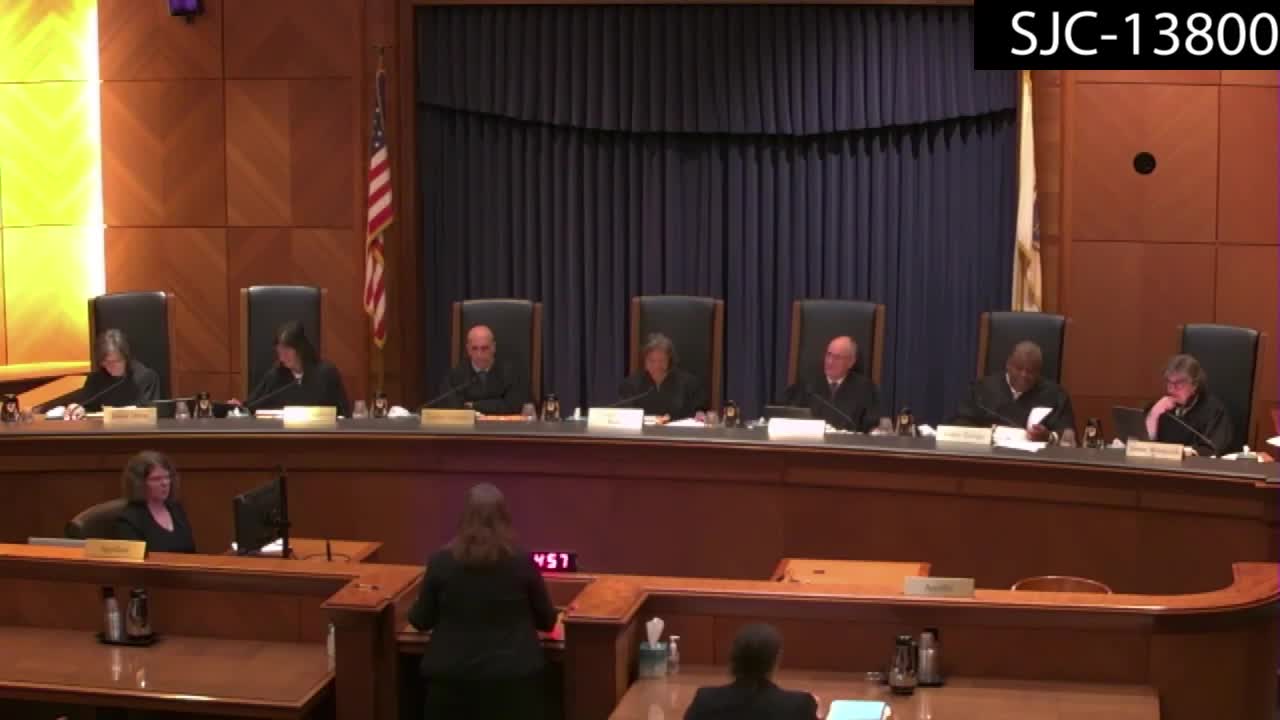
Summary
The Supreme Judicial Court heard oral argument in SJC-13800 on whether time a juvenile spent confined in the Department of Youth Services should be credited against a suspended adult sentence imposed as part of a combination sentence.
The Supreme Judicial Court heard oral argument in SJC-13800 on whether time a juvenile spent confined in the Department of Youth Services should reduce the adult portion of a later combination sentence.
Attorney Lisa Lana, representing the appellant juvenile, told the court that Massachusetts jail-credit jurisprudence is rooted in "fundamental fairness" and that the unique features of juvenile law — including protections under Chapter 119, Section 53 — require courts to treat DYS confinement as creditable toward any later adult sentence. Lana said the sentencing scheme at issue is "unique" and argued that, in practice, the DYS commitment functions in ways similar to pretrial detention for the purposes of assessing liberty lost.
Lana told the court the record in this case shows the juvenile spent substantial time in secure DYS settings and that 499 days of pretrial custody had been credited only to the adult portion of the sentence. She said the client spent roughly 18 months in confinement without receiving credit toward the adult term and that, as a practical matter, denying credit would delay the juvenile's completion of state prison: "If my client had received a straight adult sentence of 5 to 7 years ... he would complete his sentence by around the age of 21 to 23," Lana said; without the requested credit, he would finish "between the ages of 25 and 27."
Appellant counsel argued juvenile court judges are equipped to calculate how much time a youth actually spent in secure DYS facilities, and that those day counts can and have been placed on the record. Lana also said the DYS commitment is both a treatment disposition and a form of confinement; she cited cases (analogizing to civil commitment contexts) in which courts have awarded credit for time spent without liberty where failing to do so would be "fundamentally unfair."
Several justices pressed Lana on practical and doctrinal concerns. They asked how a court would determine which portions of a DYS commitment are "custodial" when the commitment can include treatment-oriented placements and community supervision. One justice observed that a combination sentence is treated by some courts as a single sentence and asked whether awarding credit would give juveniles an incentive to choose straight adult sentences or prompt judges to change how they craft suspended terms. Lana responded that denying credit could instead encourage juveniles to forgo treatment and that juvenile judges already consider multiple statutory factors under Chapter 119, Section 58 when imposing suspended portions.
After Lana rested and requested a remand ordering the additional days of credit, Attorney Emily Jomolowitz, for the Commonwealth, argued that a juvenile court judge is not authorized to award sentencing credit for post-plea DYS commitments and urged the court to affirm. Jomolowitz pointed to the statutory definition of the combination sentence (a DYS commitment plus a suspended adult sentence) and to appeals-court precedent construing those components as distinct mandatory parts. She argued that questions of so-called "fundamental fairness" cannot be used to override clear legislative intent reflected in the statutory scheme.
Jomolowitz told the court that the sentencing judge made the appropriate assessment on the record in this case and described the combination sentence as an intentionally more severe sanction than a straight DYS commitment. She urged the justices that the absence of express statutory authority to conflate the two components means credit is not available as a matter of law; she said, however, that the sentencing judge's record supported the sentence the court imposed.
The argument focused on statutory interpretation of Chapter 119 provisions and the practical mechanics of computing custody days served in DYS versus days serving an adult sentence. Counsel disagreed whether the juvenile-sentencing framework should be adapted by judges in the name of fundamental fairness or strictly applied according to the text and structure of the combination-sentence statutes.
No decision was announced from the bench. Appellant asked the court to remand with instructions to grant additional credit; the Commonwealth asked the court to affirm the lower court's sentence.