Get Full Government Meeting Transcripts, Videos, & Alerts Forever!
Get email alerts on the Seniors Services topic
No spam. Unsubscribe anytime.
Douglas County highlights ‘3 Teams’ approach to keep vulnerable seniors out of emergency care
Summary
Douglas County officials on Nov. 5 described a multi-agency effort to identify frequently used 911 patients among vulnerable seniors and connect them to non-emergency services to reduce unnecessary ambulance transports and emergency-department visits.
Douglas County officials on Nov. 5 described a multi-agency effort to identify frequently used 911 patients among vulnerable seniors and connect them to non-emergency services to reduce unnecessary ambulance transports and emergency-department visits.
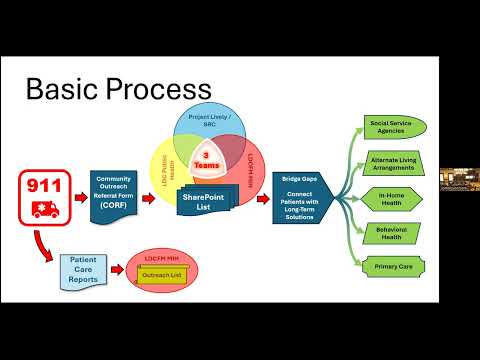
Division Chief John Darling of Lawrence-Douglas County Fire Medical said the effort’s primary aim is clear: "The goal of our process, at least from the MI side and the other 3 teams, is we want to reduce the inappropriate use of EMS in the emergency department." Staff described three partner groups — Mobile Integrated Health (MIH) paramedics, Project Lively social workers (operated through the Jayhawk Area Agency on Aging), and Lawrence-Douglas County Public Health staff attached to the Senior Resource Center — that meet weekly to review cases and coordinate responses.
Why it matters: Presenters told the commission the approach is intended to give people better alternatives than repeated EMS responses, which are costly and often fail to address root social or medical needs. Staff showed examples in which coordinated intervention avoided repeat hospital transports and improved patient conditions, and they said the effort may be slowing the county’s long-term growth in total EMS incidents.
How the system works: EMS crews use a short Community Outreach Referral Form (CORF), available on a QR-coded sticker on fire trucks, that requires only a few fields (who, where, and the immediate concern) to reduce barriers to submission. Submissions go into a SharePoint list that serves as an operational inbox; whichever of the three teams has capacity tags a case as “managing organization” and initiates outreach. Teams also create an outreach list from weekly reviews of patient-care reports to catch frequent users who were not entered on a CORF.
Staff emphasized that the CORF is intentionally minimal — "very few" required fields — so crews can submit referrals by phone in the field. The SharePoint inbox produces a visible running comment thread so team members share assessments and next steps without repeatedly calling one another.
Examples presented: Staff reviewed multiple cases. In one, after an EMS transport for heavy bed-bug infestation and blood loss, MIH and partner agencies coordinated hospital care, extermination, insurance help and follow-up wound care; staff reported improved sleep and wound healing after the intervention. In another complex case (presented as an anonymized example called “Lucy”), teams documented a drop from multiple EMS calls per month to zero EMS transports after multidisciplinary outreach, medication reconciliation, insurer and primary-care connections, and in-home supports.
Data and early outcomes: Presenters showed year-to-date dashboard data indicating most CORF referrals originate in Lawrence and that referrals from unincorporated Douglas County are underrepresented. On system-wide call volume, staff reported the county’s earlier multi-year growth in LDCFM incidents (about 8.2% per year from 2021–23) has slowed: they reported a 4.5% rise from 2023–24 and a 1.3% year-to-date increase for 2024–25. Staff cautioned the data show correlation rather than proven causation but said the collective, coordinated approach likely contributes to the change.
Limitations and next steps: Presenters identified ongoing constraints, including technology and confidentiality barriers. CORF entries populate My Resource Connection (MyRC), but MyRC is a separate login and not a closed-loop referral platform; SharePoint was developed as a practical bridge. Staff said MIH patient contacts currently are not billed, though Lawrence-Douglas County Public Health’s Jonathan Smith reported community health-worker services have been billed successfully to multiple managed-care organizations and at least one Medicare Advantage plan. Presenters also discussed a planned pilot to triage low-acuity dispatch codes (omega/alpha) to non-ambulance responders when appropriate, and they said roughly 100 omega and 1,800 alpha calls year-to-date represent potential intervention space.
Commissioner comments and staff care: Commissioners praised the cross-agency collaboration and staff supports intended to reduce burnout among frontline social workers and MIH staff. Presenters noted weekly operational reviews plus quarterly supervisory meetings are designed to sustain personnel and improve outcomes.
What remains unresolved: Staff said they need better disaggregated data on call types by municipality (falls, transportation barriers, medication issues), a more seamless closed-loop referral system, and clear policy and dispatch routing rules before expanding alternative-response staffing. They also signaled continued work to increase referrals and services for unincorporated Douglas County.
Bottom line: Douglas County’s three-team model combines short field referrals, shared tracking, and focused outreach to high-utilizer patients; staff presented case-level improvements and early system-level slowing of call-volume growth, while noting technology, data-sharing and billing hurdles that must be addressed before scaling.