Get Full Government Meeting Transcripts, Videos, & Alerts Forever!
Get email alerts on the Transportation topic
No spam. Unsubscribe anytime.
Senate debates CDL safety language as House Bill 28 advances to third reading
Summary
Senators debated amendments to House Bill 28 over whether to classify lane changes as 'improper' and whether handheld wireless use by commercial drivers should be treated as a serious traffic violation. One amendment was adopted and a second failed; the bill was ordered for third reading.
House Bill 28, a measure amending commercial driver's license (CDL) provisions and defining certain serious traffic violations, drew extended floor debate on Feb. 14, 2025 before the Wyoming Senate ordered the bill for a third reading.
The discussion focused principally on two second-reading amendments: one change to statutory phrasing about lane changes, and a second addressing use of handheld wireless devices by commercial-vehicle operators. Sponsors said the goal was improved highway safety; opponents raised concerns the language could be vague or could penalize CDL holders for conduct that occurs while driving noncommercial vehicles.
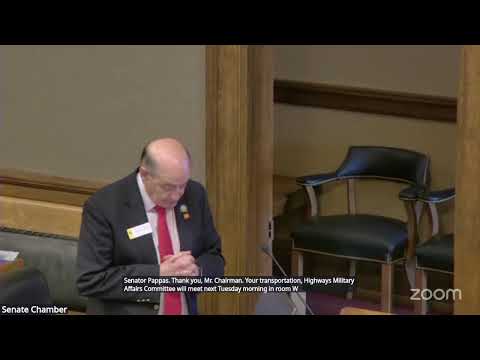
Senator Pappas, sponsor of the amendment that was adopted, argued the language provides highway patrol officers a tool to address risky driving. “We’re trying to make our roads safe,” Pappas said, noting that the term “improper” is defined elsewhere in Wyoming law and that “the ability to put your phone in a cradle and use it hands free is completely legal.”
Senator Pearson moved a different second-reading amendment aimed at removing the word “improper” (and related lines), arguing the term was vague and could capture necessary evasive actions such as avoiding a deer. “I just don't think that we should have that in there,” Pearson said, citing concerns about unintended disqualification of CDL holders.
Senators Larson and others pressed for precision. Larson said he preferred the clearer term “erratic” over “improper,” asking whether statutory language could be read to require an unrealistic amount of signaling or distance before a lane change. Senator Cobbs and other members clarified that the measure as drafted applies to drivers operating a commercial vehicle, not merely individuals who hold CDLs while driving personal vehicles.
The Senate adopted second-reading amendment number 1 (moved by Senator Pappas) after discussion. A subsequent second-reading amendment (moved by Senator Pearson) failed following debate and a voice vote. The sponsor then explained additional provisions addressing expungement and minors with CDLs, saying the bill allows review of youthful-offender records when determining commercial-vehicle disqualification. The chair noted certain hazardous-material endorsement rules are constrained by federal law.
After debate and clarifications from sponsors, the question was put that the bill be read a third time; there was no objection and the bill was ordered for third reading. The record shows several amendments and clarifications were adopted into the bill during second reading but does not show a final passage vote on third reading during this sitting.
Questions remaining in the debate included the practical enforcement implications for CDL holders, whether common-sense exceptions (such as evasive maneuvers) were protected, and how juvenile expungement rules would interact with commercial-disqualification thresholds.
Notes: The Senate discussion cited existing Wyoming statutory definitions governing lane changes and provisions exempting hands-free operation when a device is placed in a mount. The transcript records both the adoption of one amendment and the failure of a second amendment; the bill was ordered to third reading.