Tulsa economic development director outlines $630M solar plant, rocket-test center and community-led Greenwood project
Loading...
Summary
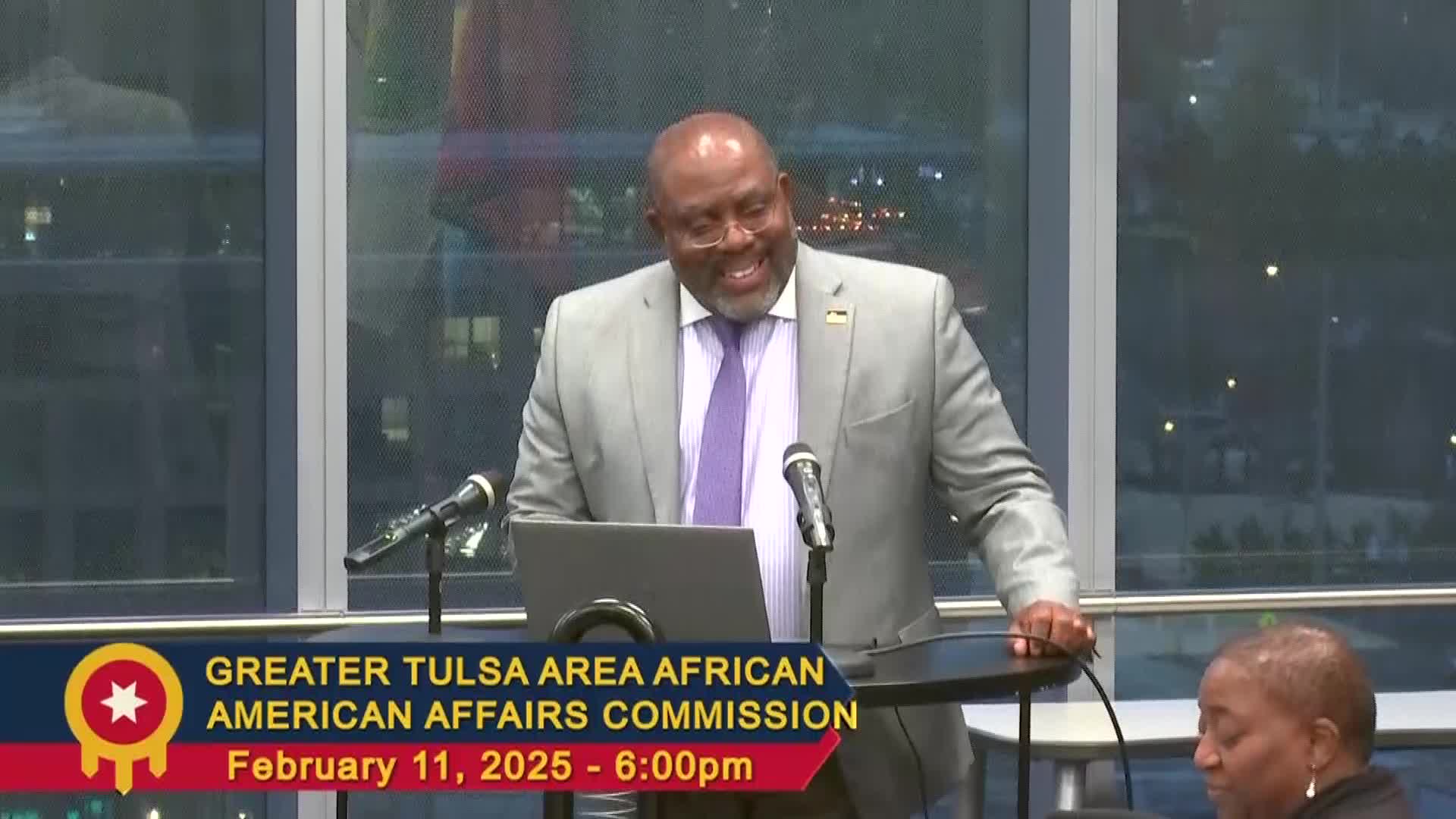
Aaron Persley, chief economic development director for the city of Tulsa, told the African American Affairs Commission that Tulsa has landed several large economic projects but needs local solutions to ensure residents can access the resulting jobs.
Aaron Persley, chief economic development director for the city of Tulsa, told the African American Affairs Commission that Tulsa has landed several large economic projects but needs local solutions to ensure residents can access the resulting jobs.
Persley said a Norwegian firm, Norsen, plans to move operations to Tulsa, representing a $630,000,000 investment and about 300 jobs. He also described a proposed Tulsa Space Testing Center near the airport that would test rocket thrusters — "the first of its kind in the U.S." — a $20,000,000 research and testing investment. Persley cited a separate $10,000,000 project tied to Crusoe (a company that makes switches used in large data centers) expected to bring about 100 jobs.
Why it matters: The city's recent wins could add hundreds of higher-paying jobs, Persley said, but many residents will face obstacles getting to work. "If you live in North Tulsa and you don't have a car, how do you get to those opportunities that are way out by the airport?" he asked, arguing that transportation, childcare and training must be part of planning so growth reaches all neighborhoods.
Persley outlined other initiatives the city is advancing. He described the Kirkpatrick Heights Greenwood project as a community-controlled development: the city provided funding and about 53 buildable acres to a community development corporation (CDC) operated by residents, who will decide uses and keep revenues. Persley said that CDC was formalized in November and is now in training; companies are already considering the site.
He also described plans for a 500—600-room hotel near the Cox Business Center and convention center to attract larger conventions. The city has vetted developer bids and plans an RFP; Persley said the city hopes to break ground by 2027 and open the hotel in 2029, though he cautioned the project would still leave Tulsa short of the hotel-room capacity typical for peer cities.
Persley highlighted a teacher down-payment assistance program in partnership with Green Country Habitat for Humanity and Tulsa Public Schools intended so teachers can afford to live in the communities where they teach. He noted the opening of Zink Lake and the retail activity it is expected to generate.
On workforce strategy, Persley urged planning for the jobs of the future rather than those of today. He cited an example of an automated electric vehicle plant overseas to illustrate how quickly manufacturing and job requirements can change and repeated a phrase he said he uses in his work: "Skate to where the puck is going." He suggested parcelizing large developments into smaller lots to allow smaller and minority developers to build capacity and participate in projects.
Commissioners asked whether incoming companies would hire and train locally. Persley said most positions for two of the announced projects will be filled locally and that companies have expressed interest in supports such as on-site daycare. He said the economic development office is coordinating with community colleges and is exploring deeper engagement with high schools and virtual-reality and artificial-intelligence training partnerships.
Persley asked commissioners for input about local needs and offered to hold working sessions. "I need that wisdom to do my job better and to serve you better," he said, inviting the commission to send ideas and contact his office.
Provenance: Presentation and Q&A from 00:03:05 to 00:39:11 in the meeting transcript.