Get Full Government Meeting Transcripts, Videos, & Alerts Forever!
Get email alerts on the Community Development Block Grant topic
No spam. Unsubscribe anytime.
Maine DECD outlines CDBG application basics; stresses income surveys and planning lead time
Summary
Maine’s Office of Community Development (DECD) summarized how communities should prepare CDBG letters of intent and full applications, emphasizing planning about a year ahead for infrastructure projects, required income surveys for targeted areas, and the need to document other funding commitments.
Terry Anne Holden, development program manager in the Maine Department of Economic and Community Development’s Office of Community Development, told planners in a March 7 webinar that the state typically receives about $11,000,000 from the U.S. Department of Housing and Urban Development for Community Development Block Grant programs and divides those funds among housing, infrastructure, business assistance and community enterprise programs.
Holden said the CDBG process is two steps: a letter of intent to establish project eligibility and, when invited, a full application. “One of the first steps being what we call letter of intent,” she said, explaining that the letter lets staff determine whether a community’s project is eligible. She urged communities to begin planning about a year in advance for public infrastructure and downtown revitalization projects because several administrative tasks — notably income surveys and cost estimates — take time to complete.
The most commonly discussed eligibility requirement for infrastructure projects is a growth-area rule cited by Holden as “Public Law 776,” which she said requires growth-related capital investments such as sewer or water main extensions to be located in a designated growth area as defined in an adopted, consistent comprehensive plan. For targeted infrastructure projects, applicants must define the geographic area of the project because that boundary establishes the income-survey universe.
Holden described the income-survey process and review steps: the applicant must perform preliminary outreach and advertising to collect survey responses, have the survey reviewed and signed off by a local economic development agency or a council of governments (for example AFCOG, KVCOG, or NMDC), and then submit the tally as part of the application. She said 70% of CDBG dollars must benefit low- to moderate-income people, which is why projects that are targeted to an LMI universe require careful survey documentation.
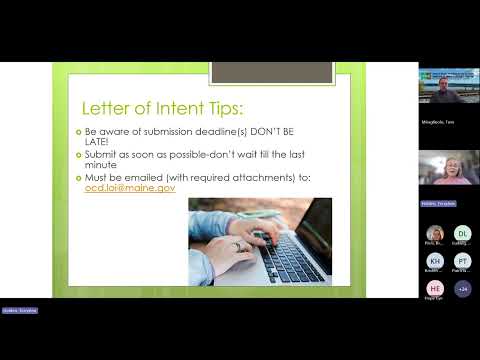
Applicants should also provide cost estimates (from engineers or contractors) and document other funding sources and commitments, Holden said. “We will be looking to see that you have your other funds lined up,” she said, adding that CDBG is typically used to fill a remaining funding gap. She recommended contacting a Development Program Manager (DPM) before submitting the letter of intent and warned that late submissions may not be considered.
On the full application, Holden said applicants should front-load the impact section with a clear opening sentence that states the project and the dollar request (for example, “Town of Springvale is requesting $500,000 to replace water lines on Main Street”), explain how the problem was discovered and how it affects low- and moderate-income residents, and summarize the expected number of people served. The strategy section should explain how the CDBG funds will be spent and provide a realistic timetable; the budget section should list and document all other funding sources and commitments. She added that strong citizen-participation documentation — public notice, community meetings and local media coverage — is critical to receiving full points in the scoring process.
Holden closed by offering follow-up assistance and advising applicants to call if they do not receive confirmation of receipt of a letter of intent. In a brief question-and-answer session after the presentation, Holden listed common CDBG-funded activities beyond sewer projects — including water mains, facades, streetscapes, lighting and limited accessibility work — and clarified that some public-facility programs (for example, full fire-station replacement) are not currently funded under the state allocation.