Get Full Government Meeting Transcripts, Videos, & Alerts Forever!
Get email alerts on the Budget Presentation topic
No spam. Unsubscribe anytime.
Germantown School District presents 2025–26 budget, highlights debt payoff, OPEB trust and enrollment trends
Summary
At the Oct. 28 budget hearing, district staff presented the 2025–26 budget and financial outlook, noting the payoff of an energy-exemption debt, the creation of an OPEB trust, increased state aid, and a modest decline in September membership. Officials also summarized capital reserves and special education funding.
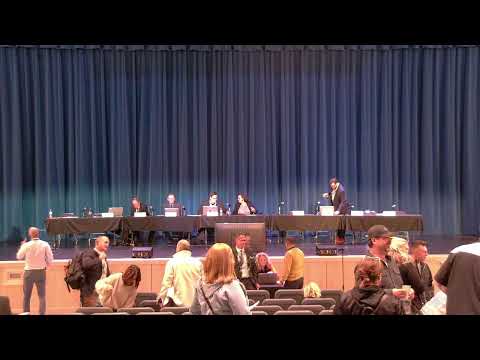
District staff presented the Germantown School District’s 2025–26 budget and financial highlights at a public budget hearing on Oct. 28, 2025 at Germantown High School Performing Arts Center.
Director of Business Britney Altendorf reviewed prior-year outcomes: the district closed the 2024–25 school year with a general fund surplus of $180,000 and reported that two major borrowings were paid off last fiscal year — the 2015 energy-exemption borrowing (original investment $7,000,000) and a $3,500,000 borrowing for Rockfield Elementary School renovation. Altendorf said total expenses over the energy-exemption repayment period were approximately $8,300,000, with estimated cost avoidance of about $4,000,000; that exemption debt was paid off on April 1, 2025, and this reporting will be the last time the district presents it at the budget hearing.
The district established an OPEB (post-employment) trust in May 2025; Altendorf said the trust balance is $650,000 and noted the trust is restricted to post-employment benefits. The district also reported a long-range capital reserve (Fund 46) balance of approximately $880,000 and a five-year capital projects budget (Fund 41) of $650,000 for 2025–26 and an additional $600,000 in Fund 46 for longer-term needs.
Treasurer Michael Loth read the fiscal-year budget figures, including a general fund budgeted revenue/expenditure line of $52,355,622.06 and total sources of $62,585,659.79 based on beginning balances and budgeted amounts. Altendorf explained the district uses WUFAR (Wisconsin Uniform Financial Accounting Requirements) coding to allocate revenues and expenses across funds.
Altendorf outlined revenue drivers for 2025–26: property taxes (~54% of revenue) and state aid (~42%). She said state aid increased 15.7% for the district and attributed part of that increase to strategic debt defeasance that maximizes state aid. The district received a declining enrollment revenue-limit exemption for a September membership count that fell by 131 students compared with the prior year, including decreases in 4K and kindergarten counts. Altendorf also noted an increase in private school voucher dollars (reported approximately $423,000) even as voucher-qualifying student counts declined, explaining rising per-student voucher amounts.
Special education (Fund 27) was budgeted at about $9.1 million in revenues and expenditures, with roughly $4.4 million from federal sources and approximately $5 million transferred from the general fund; state rules require the special education fund to end the year without a surplus or deficit, Altendorf said. The food service fund (Fund 50) is projected to use some fund balance for cafeteria equipment after showing roughly $1.6 million in revenue and $1.8 million in expenditures.
Altendorf and Superintendent Chris Reuter characterized the district’s fiscal posture as prudent: rebuilding reserves after referendum-driven construction, planning with a long-range facilities study, and continuing contributions to capital reserves to avoid future borrowing when possible. The budget hearing drew no public comment; the board then proceeded to the annual meeting where electors voted on five resolutions.