Get Full Government Meeting Transcripts, Videos, & Alerts Forever!
Get email alerts on the Dockless Mobility topic
No spam. Unsubscribe anytime.
Infrastructure Committee endorses one-year extension for dockless-vehicle contracts, asks staff to prep RFP and community outreach
Summary
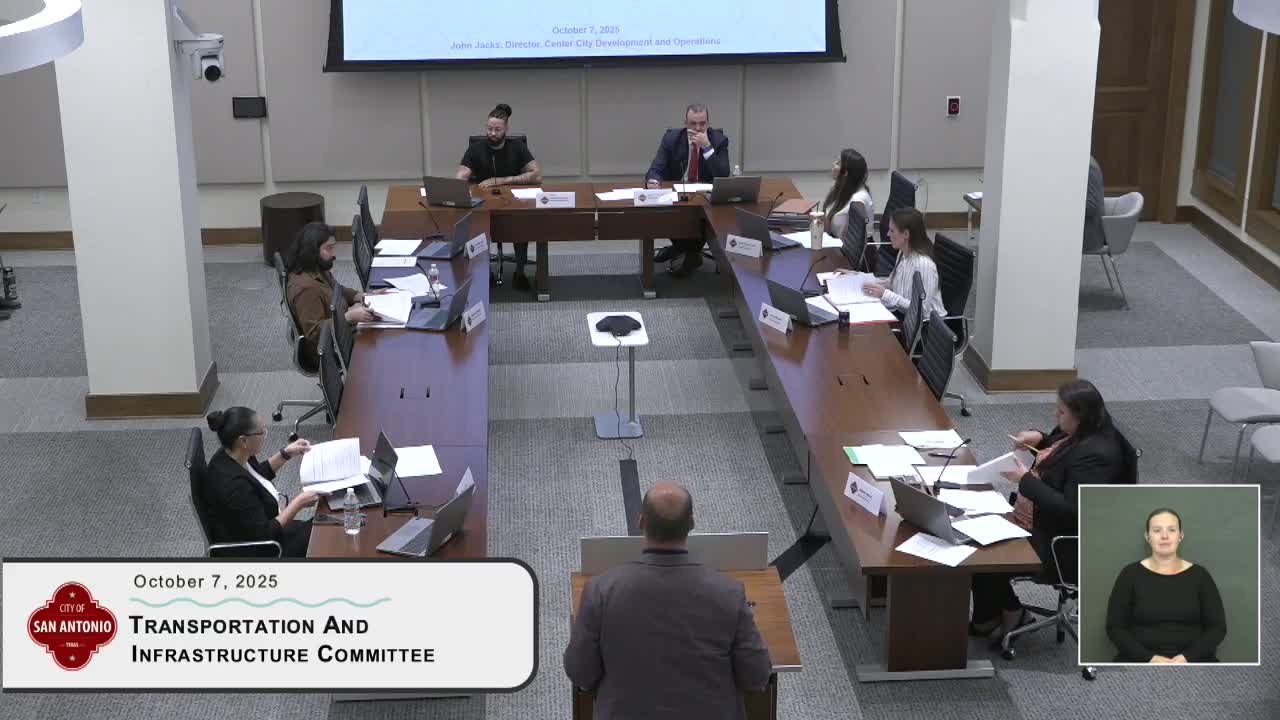
San Antonio—s Infrastructure Committee voted unanimously Oct. 7 to recommend a one-year extension of the city—s dockless micromobility contracts and asked staff to begin a new request for proposals (RFP).
San Antonio—s Infrastructure Committee voted unanimously Oct. 7 to recommend a one-year extension of the city—s dockless micromobility contracts and asked staff to begin a new request for proposals (RFP).
John Stevens, Center City Development Office, told the committee the dockless program launched in 2018 and that the city currently has two operators, Bird and Veo, each permitted to operate up to 1,000 vehicles under the existing contract structure (two-year agreements with a one-year renewal option). Stevens said since the program began more than 4 million trips have been taken and that the program generated roughly $373,000 in annual revenue in FY25 from a combination of per-vehicle fees, a per-trip revenue share and compliance fees assessed for violations in sensitive areas.
Stevens described enforcement tools the city uses downtown: geofenced no-ride footprints that stop trips and provide audible alerts, and a one-hour correction window for vehicles left in sensitive locations such as the Riverwalk and Alamo Plaza. When vendors fail to remove vehicles that remain in a geofenced sensitive area within the contract service‑level agreement, a third-party data aggregator (Populous) documents the violation and the city assesses a compliance fee; staff said FY25 compliance fees totaled about $146,000 and ridership-derived revenue about $175,000.
Committee members pressed staff for several follow-ups before the RFP is issued. Council member Munguia asked whether staff had engaged Disability SA about sidewalk obstruction and access; Stevens said they had not engaged that organization specifically but will do so before the item returns to council. Council member Aldabets Cabrillo and others asked for a map showing the city—s geofenced areas (Stevens said the downtown footprints include Main Plaza, the Riverwalk, Alamo Plaza, Market Square and Pearl) and for a comparison of San Antonio—s rules and timelines with peer cities such as Tampa. Members asked staff to provide a high-level analysis of whether adding additional vendors would affect end-user prices and to consider incentive structures (for example, discounts or in-app prompts) to encourage users to move vehicles to preferred parking corrals at transit or garage hubs.
On safety and usage data, staff said total trips rose from about 730,000 in the prior year to an expected 785,000 in FY25. Accident reports come monthly from police and fire; staff provided examples for August and September (August: one transport; two non-transport accidents; September: three transports; two non-transports) and said they would follow up with the committee with fuller accident totals. Staff also reported that trips per vehicle remained roughly flat and that operators dynamically adjust deployed fleet levels below the permitted caps.
The committee voted unanimously to endorse the one-year contract amendment so the city will avoid a service gap while the RFP is prepared; staff plans to bring the extension to full City Council in early November and to return to the committee with the RFP scope and the community feedback gathered prior to issuing the RFP.
Sources: staff presentation and committee discussion on Oct. 7, 2025.