Get Full Government Meeting Transcripts, Videos, & Alerts Forever!
Get email alerts on the Csam Law Reform topic
No spam. Unsubscribe anytime.
Children's advocacy centers and prosecutors urge law changes: rename CSAM language, study AI images and criminalize grooming
Summary
Children's advocacy centers and prosecutors asked the interim committee to modernize Century Code language that currently uses the phrase 'sexual performance by a minor,' to review penalties and enforcement for AI-generated images and growing sextortion threats, and to consider stronger hiring and homeschool safeguards.
Children's advocacy centers and prosecutors told the Legislative Management Study Committee on Sept. 30 that North Dakota statutes and practice need updates to keep pace with online technologies and evolving patterns of abuse.
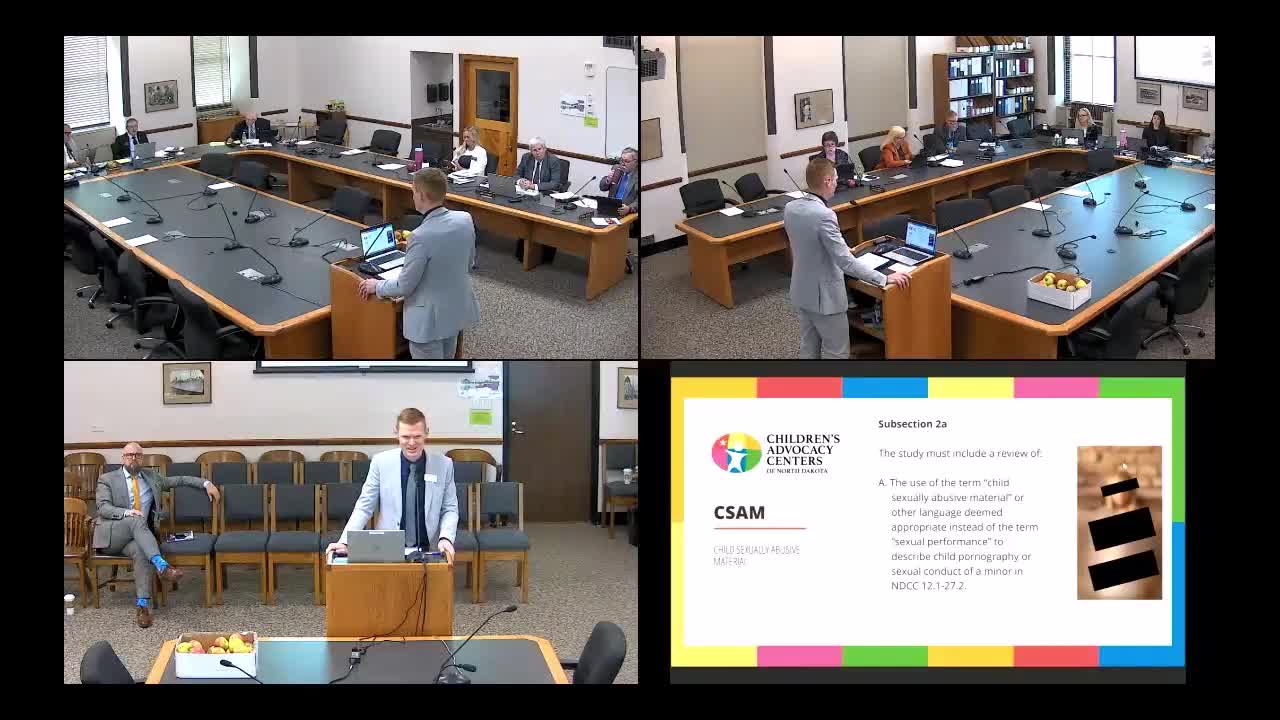
Greg Kosowski, executive director of Children's Advocacy Centers of North Dakota, presented ten recommendations the centers developed with prosecutors and other partners. He urged an audit of chapter 12.1-27.2 to remove the outdated phrase "sexual performance by a minor" and replace it with "child sexual abusive material" (CSAM) to align statutory language with modern prosecution and public understanding.
"If you open up 12.1-27.2 right now, you see ‘sexual performance of a minor' as how we refer to child sexual exploitation," Kosowski told the committee. "That phrase is outdated and carries problematic connotations. Replacing it with child sexual abusive material gives a more accurate representation of the gravity of the crime."
Kosowski also asked the committee to monitor the implementation of House Bill 1386, which added a computer-generated image definition to state law and increased penalties for possession of certain virtual images. He suggested the state evaluate whether additional prosecutorial or law-enforcement guidance is needed now that the new definitions took effect.
The centers flagged two digital-era threats needing policy attention: sextortion (coercion of victims into sending sexual images) and an emergent category the presenter described as "sadistic online exploitation," where online networks coerce or manipulate minors into violent or dangerous acts on camera. Kosowski said the FBI currently has hundreds of open investigations nationally for that phenomenon and recommended further study and awareness training for investigators.
Hiring and screening policies in schools and youth-serving organizations were singled out for change. "Perpetrators are often transient," Kosowski said. "We recommend standard questions about prior misconduct in hiring processes and stronger contact with former employers to avoid repeat hires who move from place to place." He also proposed revisiting complaint-investigation windows and called for targeted protections where homeschool environments have been used to conceal abuse.
Kosowski suggested states consider criminalizing certain grooming behaviors — conduct used to manipulate children before abuse — a measure already enacted in some other states. He also urged scrutiny of non-disclosure agreements in civil settlements that can silence victims, and urged lawmakers to consider bans on child-sex dolls and to continue dialogue about a juvenile-adult code alignment that better reflects youth-specific responses to crime.
The committee did not take formal action; members asked Kosowski for written language and evidence to support the proposed statutory changes and for follow-up briefings on how HB1386 is being applied by prosecutors in practice.