Get Full Government Meeting Transcripts, Videos, & Alerts Forever!
Get email alerts on the Xcel Franchise Ballot topic
No spam. Unsubscribe anytime.
Committee refers Xcel franchise agreement to ballot amid calls for clearer low-income, remediation and data commitments
Summary
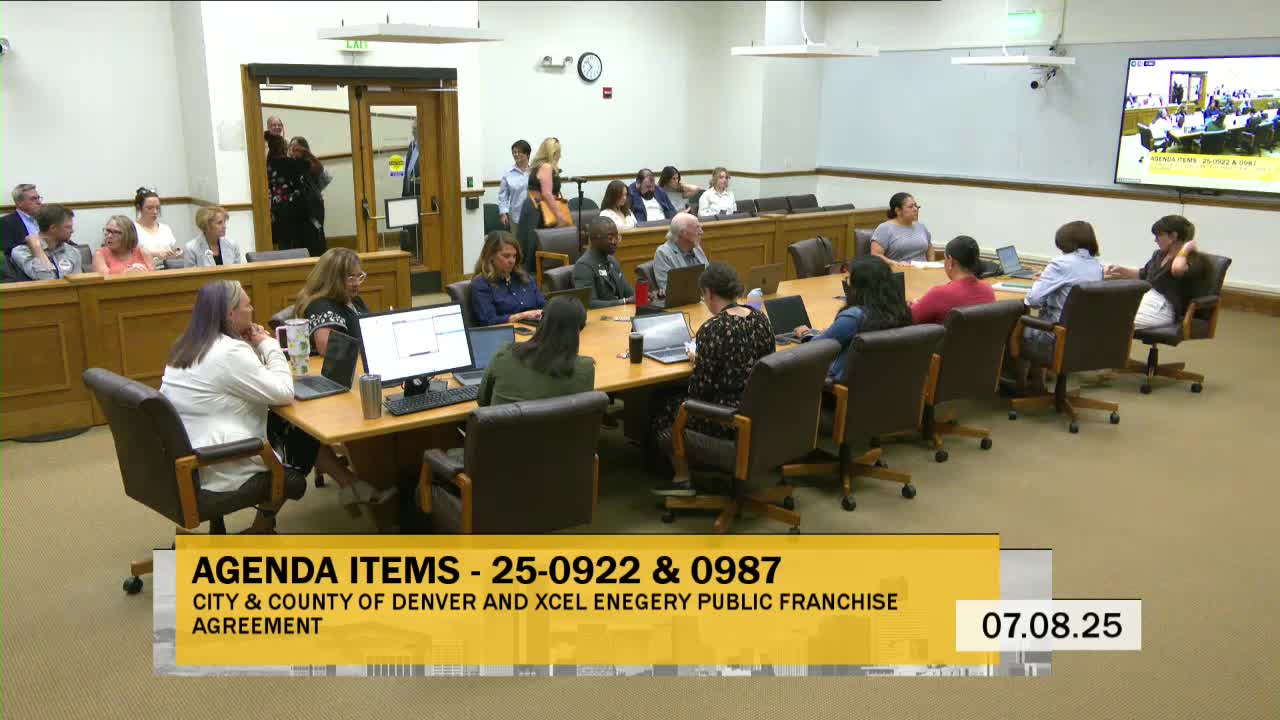
The Finance & Governance Committee on July 8 voted to refer to the full City Council a negotiated 20-year franchise agreement with Public Service Company of Colorado (Xcel Energy) for voter consideration, while public commenters and several council members urged stronger written commitments on low-income assistance, contamination remediation, and data sharing.
The Finance & Governance Committee on July 8 voted to refer to the full City Council a negotiated 20-year franchise agreement with Public Service Company of Colorado (d/b/a Xcel Energy) that would begin Jan. 1, 2027, if approved by voters and the Public Utilities Commission (PUC).
City and Xcel negotiators presented the draft agreement as a right-of-way franchise that preserves three core, voter-facing benefits from the prior arrangement: (1) the utility’s obligation to relocate infrastructure for public projects so project budgets are not borne by the city, (2) a 3% franchise fee that goes to the city’s general fund and (3) a 1% set-aside for undergrounding transmission lines. City staff said the revised package streamlines multiple prior documents and creates a new Denver Development Innovation Group (DDIG) to coordinate future energy and development work between the city and Xcel.
Grace Lopez Ramirez, Xcel’s local government and community affairs representative, detailed corporate and foundation investments to Denver-area nonprofits and programs. Xcel said it spent foundation and program dollars in the city and county of Denver in 2024 and cited partnerships with Energy Outreach Colorado and local nonprofit grantees. Staff and Xcel representatives emphasized that the franchise agreement does not set utility rates; rates are the province of the Public Utilities Commission.
Public commenters — including representatives of Together Colorado — urged the council to delay a ballot referral until the city negotiates a companion agreement or explicit guarantees for low-income bill-assistance, environmental justice measures and remediation of contaminated utility sites. Katie Linsberg (Central Park resident and volunteer with Metro Caring) said, “I am concerned this franchise agreement does not adequately address affordability, especially how it impacts our lower income and fixed income neighbors.” Thomas Wyler of Together Colorado said a 20-year agreement is a "once in a generation" decision and asked why the city would not secure stronger direct benefits.
Council members pressed staff on several points during committee: the source and permanence of bill-payment assistance programs, the absence of community input in the negotiation phase, whether environmental remediation (coal ash cleanup) could be required, and whether stronger data‑sharing and minimum commitments for Denver ratepayers could be appended as a companion agreement. City staff and the city attorney’s office said many of the regulatory mechanisms for bill‑payment assistance and clean-energy requirements now exist at the state and PUC level; they argued the franchise document is intended to govern right-of-way terms while other environmental and rate matters are handled in their appropriate regulatory forums or via separate agreements.
Several council members asked whether a shorter term (10 years) would permit faster renegotiation of benefits; staff said a 20‑year term helps lock in the relocation and other negotiated benefits for Denver and noted buyout/termination provisions exist. Council members requested clearer, written commitments and better community engagement before a final voter referral.
The committee approved a motion by Council Member Daryl Watson, seconded by Council Pro Tem Diana Romero Campbell, to move the two franchise items as a block to the full council for ballot referral. The committee transcript records that the referral was approved; no roll-call vote tally is in the committee record.
Key details from committee: - Draft ballot language presented for a 20-year franchise beginning 01/01/2027 with Public Service Company of Colorado (Xcel Energy). - Core retained benefits in the draft: relocation obligation for public projects, 3% franchise fee to general fund, 1% undergrounding set-aside. - Creation of Denver Development Innovation Group (DDIG) to coordinate future energy planning and collaboration; DDIG is described as a forum rather than a binding commitment. - Xcel foundation and program investments in Denver cited (presenters cited roughly $8.3M of activity in 2024 across state and local programs, with $1.4M in Colorado foundation dollars; presenters said most foundation grants in Colorado are headquartered in Denver).
Items not resolved in committee: community groups asked for a companion agreement to guarantee minimum investments for low-income bill assistance, explicit remediation commitments for legacy coal-ash sites and stronger data-sharing provisions; staff said those topics may be better addressed through PUC proceedings, separate agreements, or the DDIG, but did not present a finalized companion agreement.
The committee referred the franchise items to the full council; subsequent ordinance language, any companion agreements, PUC review, and formal ballot language will be part of the full-council and regulatory processes.