Get Full Government Meeting Transcripts, Videos, & Alerts Forever!
Get email alerts on the Appointments Gswa topic
No spam. Unsubscribe anytime.
Guam committee hears support for reappointment of two Solid Waste Authority directors amid rate, landfill concerns
Summary
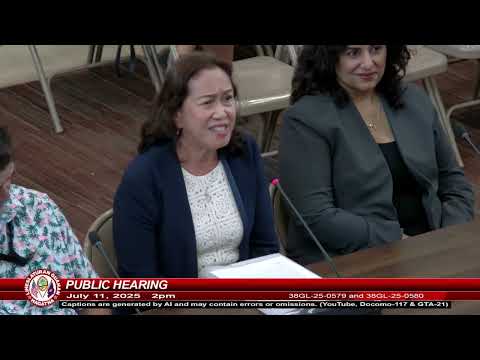
Two long‑serving members of the Guam Solid Waste Authority board — Corazon R. Montalano and Meenakshi B. Hemlani — appeared before the Legislature’s Committee on Transportation, Tourism, Customs, Utilities, Federal Foreign Affairs on July 11, 2025, for confirmation hearings as senators probed GSWA finances, a pending PUC rate petition, and plans for universal trash collection.
Two long‑serving members of the Guam Solid Waste Authority board — Corazon R. Montalano and Meenakshi B. Hemlani — appeared before the Legislature’s Committee on Transportation, Tourism, Customs, Utilities, Federal Foreign Affairs on July 11, 2025, for confirmation hearings as senators probed financial pressures at the authority and plans for universal trash collection.
Andrew Gale, chair of the GSWA board, told senators he strongly supports the reappointments, saying both nominees bring “integrity, diligence, and vision” and “professional expertise” in legal and public‑finance matters that are valuable as GSWA modernizes operations. He urged the committee to confirm the nominees so the board can continue oversight work.
Montalano, a retired utility finance executive, told the committee she has nearly 30 years’ experience in utility finance, rate cases and cost‑of‑service work and has previously assisted in filings before the Public Utilities Commission. She said GSWA has not raised rates for several years, revenues have been flat while expenses have risen, and post‑closure care for the Ordot dump is a heavy, ongoing expense. “That alone takes a toll on the financial condition of Guam Solid Waste,” she said.
Senators questioned Montalano about disclosed consulting work. She said she performs accounting and small‑business consulting unrelated to GSWA work, and that she would recuse herself if a personal consulting client appeared before the authority.
A major focus of the hearing was a pending PUC rate petition and the impact of proposed island‑wide mandatory collection legislation. Montalano and GSWA staff said models show mandatory universal collection could lower monthly residential rates by expanding the customer base; Montalano cited a modeled drop from roughly $30–$35 per month to about $22 per month if all residences participate.
Urs Laich, GSWA general manager, told the committee procurement and logistics would determine the timeline for universal collection. He said the authority needs roughly 40,000 trash and recycling carts; the current estimate for procurement and delivery is at least 12 months from purchase order approval and can be delayed further by procurement protests. Given those constraints, Laich said GSWA plans for phased implementation and is targeting full implementation in January 2028 to avoid large short‑term revenue losses.
On diversion strategies, Montalano urged public education and increased household composting, saying backyard composting cut her household refuse in half. Senators and staff pressed for commercial‑first composting (restaurants, hotels, supermarkets) as a higher‑yield, lower‑contamination approach; Laich said prior plans recommended starting with commercial generators and using grants to distribute compost bins to households.
Meenakshi Hemlani, an attorney and board member first appointed in 2017, described board accomplishments including post‑closure planning, steps toward an electric or biodiesel collection fleet, and proposals for using closed landfill areas for solar panels. Hemlani said the board has worked to improve transparency by posting monthly meetings and materials online.
Multiple senators praised both nominees and asked about term lengths, tipping‑fee affordability, landfill life and receivership history. Montalano and Hemlani emphasized planning for future landfill needs, funding post‑closure care, and avoiding a return to receivership. No formal vote was recorded during the hearing; the committee recessed to consider next agenda items and will accept written testimony for seven days.
The hearing transcript shows the committee probed both operational details (procurement timelines and cart counts) and policy choices (lifeline rates, mandatory collection, commercial composting), but did not record a final confirmation vote at the session’s close.