Get Full Government Meeting Transcripts, Videos, & Alerts Forever!
Get email alerts on the Budget topic
No spam. Unsubscribe anytime.
Marathon County committee outlines 2026 budget approach, flags compensation and utility risks
Summary
The Resources, Finance & Property Committee reviewed staff recommendations to guide 2026 budget development, framing three policy questions — which programs to provide, at what level of service, and at what cost — and discussed revenue assumptions, a planned wage-grid update, and uncertainties for insurance and utility costs.
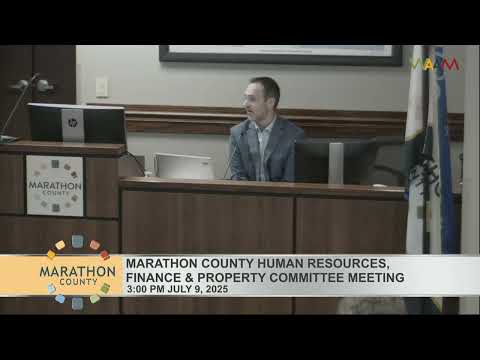
The Marathon County Resources, Finance & Property Committee on July review-focused staff recommendations for developing the 2026 county budget, aiming to give committees early direction before the administrator presents the full proposed budget in September.
Administrator Leonard told the committee the budget process is intentionally staged so standing committees can guide staff on three policy questions: which programs and services to provide within state statute, what level of service the county should seek, and at what cost those services should be provided, including when to cover costs with fees versus levy funding.
Leonard and other staff recommended placeholder revenue assumptions to begin the budget build: a net new construction estimate of 1.75 percent (to be finalized by the Department of Revenue on Aug. 1), sales tax budgeted at $16.3 million, shared-revenue growth of about 4.9 percent (roughly $261,000), and a flat projection for the county's utility tax. Staff noted many assumptions will be refined during the process as firm figures become available.
On compensation, Leonard said the county needs to move its wage grid to better match market pay; staff work with a consultant indicates minimums and other pay points likely must shift roughly 10 percent to close gaps. The committee directed staff to schedule a consultant presentation on proposed grid changes so members can weigh options for benchmarking (for example, median market or higher percentiles) before setting final salary decisions.
Members flagged benefit and other cost drivers. Leonard and Molly (human-resources staff) outlined benefit assumptions: a 6.5 percent placeholder for health-insurance renewal, and a roughly 2.08 percent weighted employer increase in Wisconsin Retirement System (WRS) contribution rates based on preliminary figures. Committee members asked staff to analyze stop‑loss and deductible adjustments and seek further detail from the county's insurance broker prior to finalizing assumptions.
Committee members also pressed for more detailed breakdowns for program-based staffing and FTE allocation across discretionary programs, and for a consolidated view of procurement to capture potential savings. Supervisors urged staff to provide a roll‑up of personnel, contractual services and other costs associated with discretionary programs to allow apples‑to‑apples comparisons when prioritizing resources.
Chair Robinson and staff emphasized the timeline: committees will provide input through September, the administrator will deliver a proposed budget to the full county board in September, committees will refine it in October, and the board will hold a public hearing and adopt a final levy in November. Staff said they will return with more precise figures on net new construction, insurance renewals, and compensation costings as they become available.
Leonard closed by asking committee members to identify specific programs they want staff to analyze in greater depth so the administrator can bring targeted data and options to future meetings.