Get Full Government Meeting Transcripts, Videos, & Alerts Forever!
Get email alerts on the Wildlife Management topic
No spam. Unsubscribe anytime.
Grant County public commentators and some commissioners urge support for neighboring countieson Mexican gray wolf emergency declarations
Summary
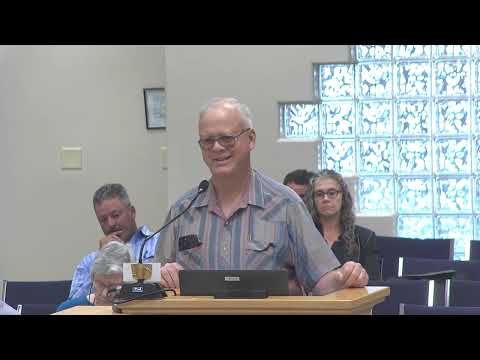
A string of public commenters on Tuesday urged the Grant County Board of Commissioners to back Catron and Socorro counties in emergency declarations related to Mexican gray wolf depredations and public-safety concerns.
A string of public commenters on Tuesday urged the Grant County Board of Commissioners to back Catron and Socorro countiesin emergency declarations related to Mexican gray wolf depredations and public-safety concerns.
Ty Bates, president of the Mexico Federal Adams Council, said the wolf presence is "a crisis," saying ranchers are "losing 30% of their livestock production" and asking the board to "support this resolution." James Dines described photographs he said show wolves near ranch houses and told commissioners that he had to put down a ranch dog he said had been attacked by a wolf.
Deborah Muller, Catron County manager and administrator of the county livestock loss authority, told the commission that wolves were reintroduced in 1998 and that, through December 2024, "it's cost the federal government about $74,000,000" and that there were "286 known Mexican wolves between Arizona and New Mexico." Muller said wolves are encroaching into developed areas and that Catron County held three hours of testimony in April about pets and livestock killed "in town." Nelson Shirley, designated representative to the Mexican Wolf Executive Committee, described what he called a "habituated population of wolves" and a density he compared to Yellowstone, saying "we've got a density 3 times that of Yellowstone."
Commissioner Shelley, who introduced a draft resolution (R-2540) supporting Catron and Socorro counties' declarations, said the measure is intended as a request for intergovernmental assistance to counties facing what she described as public-safety emergencies and heavy ranching losses. "This resolution does not criticize the reintroduction of wolves," Shelley said, adding that it seeks better management and help for ranchers and communities. Chairman Ponce reiterated concern for livestock, rural livelihoods and public-safety issues, and said the issue was meant to bring agencies together to "figure out a better way to manage a wolf population." Commissioner Stevens said he was sympathetic to ranchers but expressed reservations about adopting a county resolution, noting he had constituents who oppose the measure and that he was "not yet convinced of that" Grant County faces a wolf disaster.
No formal vote on R-2540 occurred at Tuesday's work session. The resolution was scheduled for consideration on the board's Thursday regular meeting agenda; the draft as presented asks the county to support Catron and Socorro Counties and to request state and federal assistance. The county manager also flagged a related news item that a bill was circulating seeking changes to the Endangered Species Act; commissioners said that action would be a separate matter for federal authorities.
The public comment portion of Tuesday's meeting featured multiple speakers in favor of supporting Catron and Socorro Counties, including local ranchers and representatives of livestock organizations. Several speakers tied the wolf issue to broader concerns about forest and wildlife management and fire suppression, referencing the recent Trout Fire and broader landscape management issues.
The board did not adopt any immediate emergency authority or change county policy during the work session; the resolution and related agenda items were scheduled for the upcoming regular meeting.
Sources: public comment recorded at the Grant County Board of Commissioners work session (see provenance).