Get Full Government Meeting Transcripts, Videos, & Alerts Forever!
Get email alerts on the Water Delivery Program topic
No spam. Unsubscribe anytime.
Commissioner’s office details $50 million water-delivery program to benefit Great Salt Lake
Summary
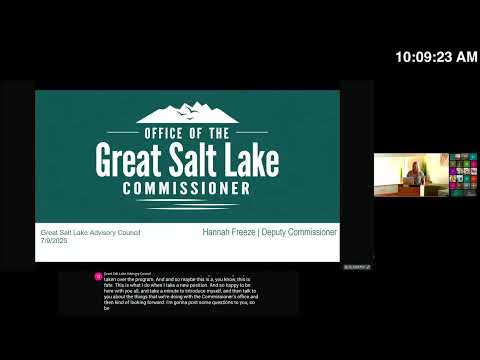
Hannah Friese, deputy commissioner for the Great Salt Lake Commissioner's Office, told the Great Salt Lake Advisory Council that the office will roll out a $50,000,000 program funded through the Bureau of Reclamation and tied to IRA appropriations.
Hannah Friese, deputy commissioner for the Great Salt Lake Commissioner's Office, told the Great Salt Lake Advisory Council that the office will roll out a $50,000,000 program funded through the Bureau of Reclamation and tied to IRA appropriations.
Friese said the program is organized into three "buckets": voluntary water transactions, system conservation (infrastructure) projects, and ecosystem and habitat restoration. "The first bucket of projects will be voluntary water transactions," she said, explaining the office is prioritizing large-volume leases — generally at least about 1,000 acre-feet — that would require an approved change application with the Division of Water Rights and the state engineer.
The second bucket will fund infrastructure to improve system efficiency, with an expectation that projects will include temporary or permanent dedications of water to the lake. The third bucket will support ecosystem and habitat restoration projects similar to those funded by the Great Salt Lake Watershed Enhancement Trust.
Applications will open the week after this meeting, remain open through Sept. 15, and the office anticipates selecting recipients in November; the Commissioner's Office said RFP details will post to its website on July 15. Friese emphasized project prioritization criteria will favor proposals that can demonstrate a reasonable delivery pathway to Great Salt Lake, long-term sustainability, and, for infrastructure projects, shovel-readiness so funds can be spent by 2030.
Friese said the $50 million award has no required match: "This $50,000,000 does not have any match fund requirement," she said, while acknowledging matching funds are encouraged where available. She recommended pre-consultation with the Division of Water Rights for applicants planning transactions that require a change application.
Council members and liaisons asked several substantive questions. Brad Perry asked whether the program is limited to a fixed radius; Friese replied that ecosystem and habitat restoration projects will be prioritized within seven miles of the lake’s meander line, while voluntary transactions and system conservation projects are eligible basin-wide. Tom Ward asked whether IRA funds are secured; Friese confirmed the funds are available to the state and noted the money must be fully expended by 2030.
Members also discussed outreach to agricultural producers, verification of delivery for leased water, and possible inclusion of additional agricultural representation on the council. Friese described staff work to support producer outreach, including a proposed calculator modeled on crop revenues to help producers evaluate the financial effects of leasing water.
The office also said it will coordinate its announcement with the Great Salt Lake Watershed Enhancement Trust’s wetlands funding opening and invited the council to help review aspects of the commissioner’s strategic plan for 1-year and 1–5-year goals.
The council did not take a formal vote on the program during this meeting; Friese asked for feedback and said the staff will publish application materials and criteria on the Commissioner's Office website.