Get Full Government Meeting Transcripts, Videos, & Alerts Forever!
Get email alerts on the Ranch Management topic
No spam. Unsubscribe anytime.
City outlines long‑term plan for Monolith and Hart ranches, emphasizes water rights and infrastructure upgrades
Summary
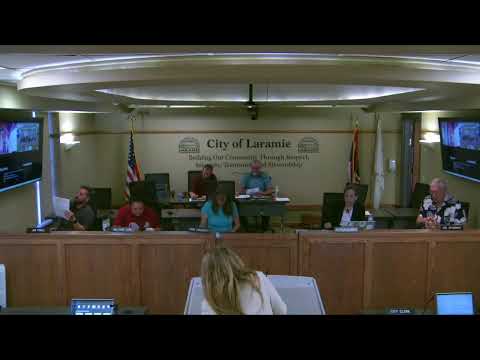
The Laramie City Council met in a joint work session with the Ranch Advisory Commission on July 8 to review the history, operations and a draft comprehensive plan for the Monolith and Hart ranches, emphasizing that the properties are held primarily to protect senior agricultural water rights and that a three‑year pause on grazing leases will be used to assess infrastructure and operational needs.
The Laramie City Council met in a joint work session with the Ranch Advisory Commission on July 8 to review the history, current operations and a draft comprehensive plan for the Monolith and Hart (formerly Bath) ranch properties. City staff emphasized that preserving and exercising agricultural water rights remains the primary purpose for municipal ownership and that a phased, multi‑year approach will guide any future transfer of water to municipal use.
City water resources for Laramie come from two main sources, staff said: roughly 10 cubic feet per second diverted from the Laramie River (about 40% of average annual supply conveyed through the city’s water treatment plant at Woods Landing) and the remainder from wells and springs in the Casper Aquifer. Ben Levin, director of the city’s ranch program, told the council that the ranch purchases were driven by water rights considerations: “Again, the number 1 priority is protecting and exercising these water rights for that potential transfer to municipal use.”
The Monolith property was acquired by the city in 1981 for about $3,000,000 and carried senior water rights on the Dowlin Ditch. The Hart Ranch — purchased in 2022 using municipal bonds — added approximately 4,600 acres to the city portfolio of a larger ~8,200‑acre historic parcel; together the Dowlin Ditch carries roughly 36 cubic feet per second and the city holds roughly 31 cubic feet per second of that senior priority flow (staff described the total as “just over 31” cfs, equivalent to about 21 million gallons per day for a 32 cfs figure cited elsewhere in the presentation).
Because water rights require continued beneficial use, the city currently operates the ranches for full agricultural production. Levin said the council recommended letting the prior 22‑year grazing lease expire and adopting a three‑year pause on major grazing or long‑term contracts to allow staff and the Ranch Advisory Committee (RAC) to complete infrastructure and ecological assessments and prepare a unified operations plan. The pause is intended to produce a baseline inventory — fencing, irrigation infrastructure, culverts, roads, soil and range health — and to prepare for any prospective grazing lease or other land uses that may be proposed after the pause ends.
Levin and Phil Zimmerman, ranch supervisor, outlined current priorities: integrating irrigation networks between the two ranch parcels, reducing ditch conveyance losses by using smaller, more efficient channels, evaluating and potentially fencing riparian stretches (Levin said roughly five miles of riverbank on the Hart Ranch would need fencing before livestock were returned), and increasing equipment and tool inventories so routine maintenance can be performed in‑house. A major capital project discussed is the Dowlin diversion replacement, a roughly $2.5 million engineering project scheduled to begin Sept. 1; staff said most of the cost is grant‑funded with a local match.
Staff highlighted the economic value of hay production: historically the ranch produces multiple thousand tons of hay per year (Levin cited three to four thousand tons as a typical range), sold under three contracts (Monolith, Hart, and the center pivot). Levin gave a sample revenue estimate using $100–$115 per ton as a market reference, which would put annual hay receipts in the low hundreds of thousands of dollars in an average production year. The 260‑acre center pivot was singled out as both an efficiency asset and a point of operational risk because its irrigation efficiency increases the agricultural-to‑municipal transfer credit if water rights are converted.
Beyond production and water, council heard several concurrent priorities that will be included in the comprehensive plan: soil and range health and rotational grazing standards, historic‑structure preservation (the Hart Ranch may be nominated for the National Register), wildlife and habitat stewardship (including coordination with U.S. Fish and Wildlife and Wyoming Game and Fish), and public access that balances recreational use with protection of water‑supply assets.
Council members and RAC representatives asked about using lidar and remote sensing to map historic irrigation traces, staffing needs (the ranch currently has one full‑time supervisor and one seasonal employee), and the potential for revenue streams from solar developers or carbon credits. Levin described the Sailor Solar project as active but searching for a power purchaser while conducting biological studies; he said carbon credits are under consideration but would require long‑term agreements and careful vetting.
Public commenters urged consideration of rotational grazing practices and local experience when evaluating future leases, raised mosquito concerns tied to flood irrigation, and suggested expanding regulated hunting and fishing access programs (lottery or guided permits) as revenue and public‑access options. Edward Siegel, a local rotational‑grazing practitioner, encouraged the council to weigh experience in soil/water stewardship when selecting lessees: “Maybe not taking the highest bid, but taking into consideration people that have been practicing this type of rotational grazing and soil management.”
Levin and RAC members said the comprehensive ranch plan is intended to be an evergreen operations manual that captures irrigation procedures, carrying capacities developed with NRCS partners, rotational grazing guidance, infrastructure inventories and maps, and appendices with maps and grazing/fencing plans. Staff recommended continuing regular RAC input and public engagement while completing the assessments during the three‑year pause. No formal council action or vote occurred during the session.
Looking ahead, staff listed follow‑up tasks and constraints: engineering assessments for secondary diversions, funding strategies for fencing and historic building repairs, continuing invasive‑weed control across ~16,000 acres, and prioritizing projects that reduce repeated maintenance demands so staff can shift from repair to strategic upgrades. The Dowlin diversion replacement and fencing of riparian areas were identified as near‑term priorities; longer‑term municipal transfers of water rights were described as a phased possibility many years away and dependent on city growth, treatment plant capacity and groundwater reliability.
The council thanked staff and RAC members for the presentation and invited tours of the ranch properties; no binding decisions were taken at the work session.