Get Full Government Meeting Transcripts, Videos, & Alerts Forever!
Get email alerts on the Economic Outlook topic
No spam. Unsubscribe anytime.
Department of Labor and BSP say Guam economy should continue expanding in FY26 amid military and tourism gains, but structural fiscal and workforce issues merit
Summary
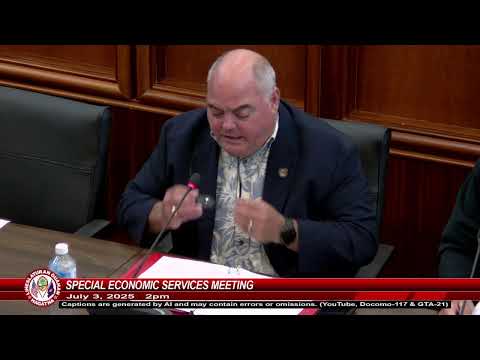
Department of Labor (read statement by Chief Economist Gary Hiles) and BSP presented an economic outlook that anticipates continued expansion in FY26 driven by tourism, construction and DoD personnel increases; UOG economist Dr. Rosanna Jones cautioned that Guam faces structural fiscal challenges, including a tax gap and declining labor‑force
Christian Valencia of the Guam Department of Labor read a statement by Chief Economist Gary Hiles summarizing the FY26 outlook. The statement said Guam's economy is expected to continue expanding and recovering from the pandemic into FY26, driven by increased tourism, construction and the arrival of additional DoD personnel. Hiles' statement cited new retail and telecom investments (Bank of Hawaii branch opening, grocery chain openings, GTA data‑center construction) and noted authorizations and allocations for planned defense projects in recent National Defense Authorization Act language.
Matt Santos (BSP) provided transactional federal obligations and a breakout by contract category, noting that obligations do not equal immediate expenditures; many FY25 awards remain to be spent. Santos highlighted a delayed NOFO cadence due to continuing resolutions and forecast that some FY25 expenditures will be deferred into FY26.
University of Guam economist Dr. Rosanna Jones gave prepared remarks warning that Guam's revenue structure is heavily reliant on federal spending (about 34% of GDP) and identified a roughly 10 percentage‑point tax gap indicating collection inefficiencies — a potential source of recurring revenue opportunity if addressed. Dr. Jones emphasized the scale of the military construction phase, multiplier effects (she cited an estimate that each dollar of defense spending generates about $0.75 of additional GDP), and the importance of aligning workforce development and infrastructure investments to capture dual‑use benefits for both defense and civilian economies. She recommended strategic coordination to diversify beyond tourism and defense dependence and to invest in workforce training, digital infrastructure and regional integration.