Get Full Government Meeting Transcripts, Videos, & Alerts Forever!
Get email alerts on the Code Enforcement Procedure topic
No spam. Unsubscribe anytime.
Ocala code-enforcement board gets refresher on hearings, Sunshine Law and fines
Summary
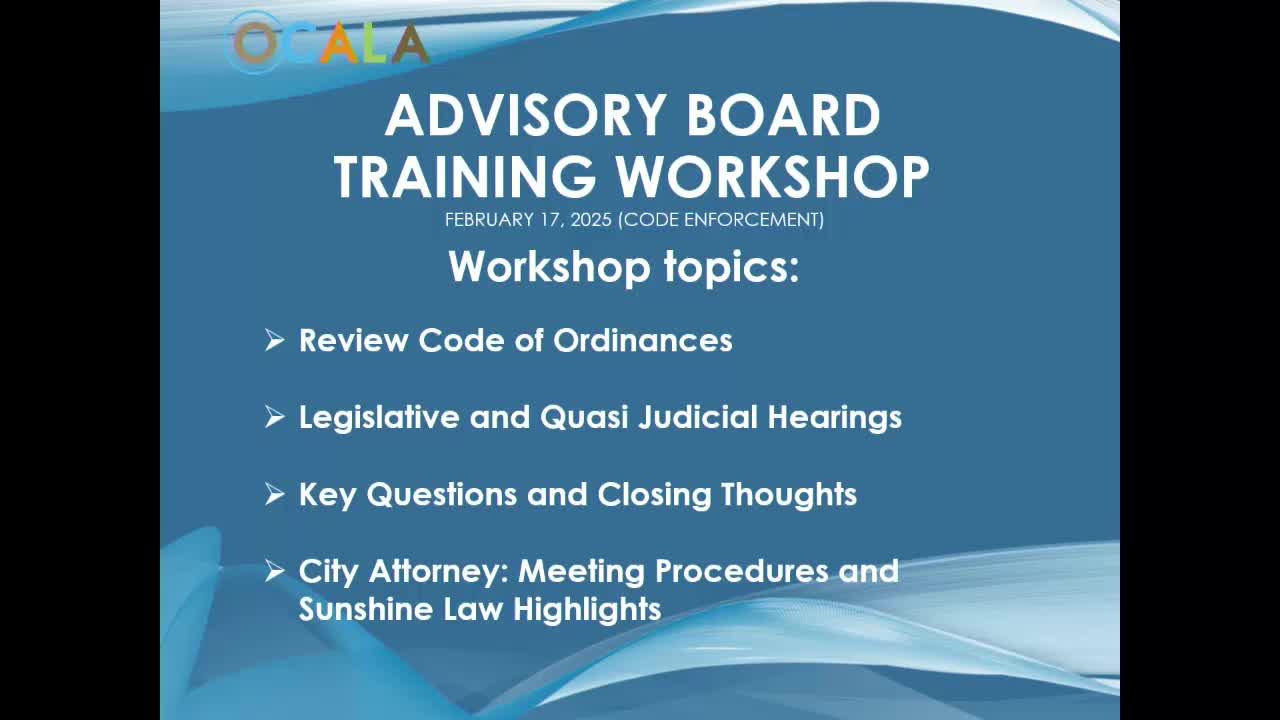
At a training session, Jeff (staff member) and City Attorney Will Sexton reviewed the City of Ocala Code Enforcement Board's statutory role, hearing procedures, and enforcement tools, emphasizing that the board's principal objective is to obtain property compliance rather than to collect fines.
At a training session, Jeff (staff member) and City Attorney Will Sexton reviewed the City of Ocala Code Enforcement Board's statutory role, hearing procedures, and enforcement tools, emphasizing that the board's principal objective is to obtain property compliance rather than to collect fines.
The session summarized the board's authority under local ordinance and state law, the difference between legislative and quasi-judicial proceedings, evidence and notice requirements, and practical enforcement topics such as setting compliance deadlines, using daily fines, applying an immediate up-to-$5,000 assessment for irreparable harms, and pursuing liens. "You really ask the the tough questions that need to get asked. You approach your job with fairness," Jeff said of the board's conduct. City Attorney Will Sexton summarized the Sunshine Law and its application to the board: "All of the business of the Ocala Code Enforcement Board must be conducted in a public meeting that's open to the public," he said, noting the three core requirements of notice, public access and records.
Why it matters: the board hears alleged code violations that can affect public health, safety and neighborhood conditions. Procedures the board follows'from evidence handling to conflict avoidance and notice'help ensure decisions are legally defensible and less likely to be overturned on appeal.
Key facts
- Legal framework: Presenters pointed board members to the City of Ocala Code (Chapter 2, Article 5) as the local ordinance establishing the board and cited Chapter 162 of the Florida Statutes for the state code-enforcement process; Sexton also referenced Section 286.011, Florida Statutes (the Sunshine Law).
- Quasi-judicial standards: The board should base decisions solely on competent, substantial evidence presented at the hearing (staff reports, dated photographs, sworn officer testimony, and respondent evidence). Jeff and Sexton warned against ex parte communications (private conversations, site visits just before a hearing, or private texts/emails about positions), which can create a disqualification risk.
- Evidence and the record: Respondent-submitted photos or paper plans are admissible evidence if offered at hearing; the attorneys recommended collecting and preserving copies in the case file so the record supports any later appeal. Sexton said it is generally appropriate to accept such evidence to avoid denying due process but to ensure a copy becomes part of the official record.
- Fines and remedies: Staff explained how the board weighs three factors when setting fines: the gravity of the violation, corrective steps taken by the respondent, and the property's value. Code allows daily fines to accrue and permits an immediate assessment (discussed as up to $5,000 in the meeting) when a violation causes irreversible or irreparable harm (examples given included contamination or environmental impacts). Staff and board members debated daily fine levels during examples (daily amounts were discussed in the meeting as $200'$250 in different contexts); presenters underscored that the enforcement purpose is compliance rather than punishment.
- Compliance timelines and permits: Staff urged the board not to feel bound by a building-permit duration when setting compliance deadlines if progress is not being made. Typical compliance milestones that may be required include permit application, permit issuance, permit final inspection and certificate of occupancy; the board can require intermediate steps to demonstrate progress.
- Liens and collection limits: Jeff told the board the city tracks roughly a thousand liens, some approaching statutory lifespan limits (20 years was mentioned); staff said they will work with the attorney's office and possibly third parties to inventory and pursue those liens where permissible, noting homestead protections can limit enforcement against some properties.
- Administrative practice and systems: Staff said code enforcement recently moved case management to the Track It system and acknowledged ongoing problems with tablet/agenda formatting and public access to case materials; staff will coordinate with IT and the clerk's office to improve access.
- Contractor referrals and unlicensed work: Board members were reminded to avoid offering direct contractor referrals from the bench. Instead, staff suggested directing respondents to public resources such as the Marion County Builders Association or state license checks (DBPR). Jeff said staff plans to increase attention to unlicensed-contractor enforcement.
- Role of counsel and conflicts: Sexton explained that an attorney who advises staff on a particular case will not represent the board on that same case to avoid the appearance of bias; the other attorney in the office will advise the board. He urged members to contact the attorneys early if they have any perceived conflicts.
- Owner responsibility: Sexton reiterated that under the state code the named respondent is ordinarily the property owner; tenant conduct may form the factual basis for a violation, but the owner is the respondent before the board and the owner's remedies against tenants are contractual.
What board members asked: members raised procedural points about motions to continue prior orders, how to phrase staff recommendations for cases returning after progress, and how to treat evidence such as respondent photos; staff noted meeting minutes can correct imprecise phrasing of outcomes when necessary.
Next steps and outlook: Staff and the city attorney's office encouraged members to call counsel with any conflict or process questions between meetings. Staff will pursue more proactive lien tracking, improve public access to case records in the Track It system, and step up unlicensed-contractor notifications to DBPR when appropriate.