ADEQ: Contamination at Chino Valley Circle K confined to soil above aquitard; groundwater not impacted, remediation continues
Loading...
Summary
Chris Marks, a manager with the Arizona Department of Environmental Quality's corrective action unit, told the Chino Valley Town Council that ADEQ has approved the site characterization for the fuel release at the Circle K on Jan. 3, 2024, but that remediation and monitoring must continue.
Chris Marks, a manager with the Arizona Department of Environmental Quality's corrective action unit, told the Chino Valley Town Council that ADEQ has approved the site characterization for the fuel release at the Circle K on Jan. 3, 2024, but that remediation and monitoring must continue.
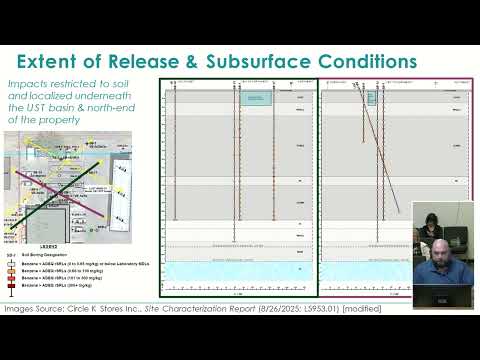
ADEQ said the investigation found contamination confined to soil above a clay-rich aquitard about 150 feet below ground and that regional groundwater and nearby private drinking wells have not been impacted. "There is no current threat to a drinking water resource by any members of the community from this release," Marks said.
The site investigation included 18 soil borings (several converted to monitoring wells), four monitoring wells screened in the regional aquifer, sampling of seven nearby private wells, and two soil-gas surveys. ADEQ said Circle K has installed remedial wells and is operating a soil vapor extraction (SVE) system that draws vapors to a treatment compound where an oxidizer treats extracted vapors.
ADEQ reported the SVE system has removed an estimated 118,000 pounds of hydrocarbons (a rough estimate equivalent to about 20,000 gallons of volatiles) and presented cross-section confirmation borings showing reductions in contaminant concentrations after roughly a year of remediation. ADEQ said these field data demonstrate the remedy is reducing contamination in soil but that the case is not ready for closure until regulators are satisfied there is no future threat to human health or the environment.
ADEQ also took issue with Circle K's operational estimate that 79,000 to 86,000 gallons were lost from a single failed component on the submersible turbine pump over about 18 days. ADEQ reviewed multiple lines of evidenceincluding automatic tank gauge hourly data, delivery records (bills of lading), the operational chronology provided by Circle K, and the environmental samplingand concluded the environmental data are more consistent with a lower overall contaminant mass and with the possibility of historic, long-term contamination that contributed to the observed soil profile.
Marks described the differences this way: inventory records and ATG data show fuel entered and left the tanks during the DecemberJanuary period, but the environmental signatures ADEQ expects from a short-term, large-volume releasesuch as extensive free-phase gasoline in basin cuttings, large vapor readings in the basin monitoring well, or an obvious overflow on the tank padwere not evident. ADEQ therefore said it could not concur that the 86,000-gallon single-event release, as described by Circle K, fully explains the contamination present.
ADEQ emphasized that regardless of the source attribution, Circle K remains obligated to remediate the site under applicable UST regulations and to demonstrate that remaining soil contamination will not leach to groundwater or pose long-term vapor exposure risks. ADEQ noted that many parties model a 30-year residential exposure scenario and that monitoring and periodic reporting are required until closure criteria are met. Circle K must submit periodic site status reports (PSSRs); the next PSSR is due in February 2026.
Council members pressed ADEQ on specific issues, including a single toluene detection in on-site monitoring well MW7 (screened above the aquitard) that ADEQ said was thousands of times below drinking-water standards and was not reproduced in subsequent sampling. ADEQ said it investigated the site septic/dry-well area as a potential source for that hit but found no recurring detections.
Council members also asked about the sump integrity. ADEQ said Circle K replaced the submersible turbine pump and that the basin sump failed a hydrostatic test after repairs; the basin was capable of holding roughly 200 gallons at one inspection. ADEQ acknowledged limitations in its ability to determine whether a long-term low-rate leak had occurred below federally established detection thresholds and said it had consulted the U.S. Environmental Protection Agency's Office of Underground Storage Tanks and had the testing method audited by the test manufacturer to verify test performance.
The council closed the discussion with a request for further accountability: the mayor asked that Circle K appear before the council within 60 days to answer questions.
What happens next: Circle K will continue SVE and monitoring, will submit required periodic reports to ADEQ (next due Feb. 2026), and must demonstrate the site meets closure criteria for protection of groundwater and long-term vapor risks.