JCAR hears Michigan Department of State rules to clarify voter‑roll challenges, adds 20‑year backstop
Loading...
Summary
The Joint Committee on Administrative Rules (JCAR) heard testimony from the Michigan Department of State Bureau of Elections on proposed rules to clarify voter‑registration challenges and list maintenance, including a contested provision that would treat 20 years of no voter activity as "reliable information" to begin cancellation procedures.
The Joint Committee on Administrative Rules (JCAR) heard testimony from the Michigan Department of State Bureau of Elections on a proposed rule set meant to clarify how clerks handle voter‑registration challenges and list maintenance, including a measure that would treat 20 years of no voter activity as "reliable information" to begin cancellation procedures.
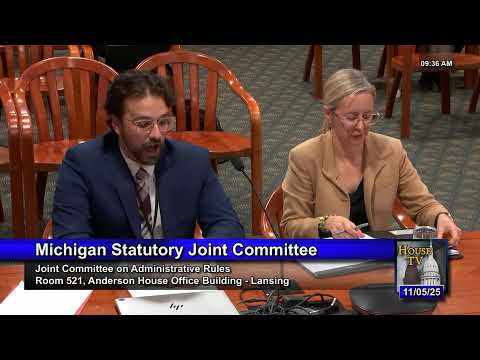
Adam Fercasse, deputy director of elections for the Bureau, told the committee the rules aim to "harmonize" the text of Michigan law with the National Voter Registration Act (NVRA) and to codify existing bureau practice drawn from the Clerk Accreditation Manual. The package, he said, separates registration‑challenge procedures from list‑maintenance procedures and provides definitions and examples intended to reduce confusion about when a clerk must act.
The rules propose a definition of "reliable information" (a term used by the NVRA) and give a non‑exhaustive list of items that qualify. "One of the biggest changes with that is we are considering we are adding in here a consideration that a voter's failure to vote for 20 years or more is reliable information that you no longer live at that address," Fercasse said. Under the bureau's proposal, reaching the 20‑year threshold would trigger a cancellation notice and start the NVRA timetable that gives a voter two federal election cycles (four years) to respond or otherwise demonstrate eligibility before the registration is canceled.
Fercasse repeatedly emphasized that the 20‑year provision is intended as a backstop for legacy records carried into Michigan's Qualified Voter File (QVF) when it was first implemented. He noted the bureau reviewed public input — 19 speakers at a Sept. 5 hearing and about 1,400 emails — and said changes based on that input are summarized in the agency's JCAR submission report.
The proposed rules also address challenge procedures under section 5 12 of Michigan election law, which the bureau interprets to require a written, notarized affidavit asserting personal knowledge when an elector files a challenge against a specific registrant. "Section 5 12 is a specific requirement ... that makes it a requirement that a written affidavit be submitted," Fercasse said. He described the rules' personal‑knowledge and notarization language as reflecting long‑standing legal principles for affidavits and as a statutory floor for 5 12 challenges.
Committee members repeatedly asked how the 20‑year trigger and the 5 12 affidavit rule would interact with other sources of information that clerks commonly receive, including undeliverable mail (bounce backs), inter‑state driver's‑license exchanges, the National Change of Address (NCOA) database, and federal verification tools such as SAVE. Fercasse said those sources can constitute reliable information that triggers the NVRA cancellation notice and its four‑year timeline, but that they would not, by themselves, satisfy the personal‑knowledge affidavit needed to shorten the process to the 30‑day cancellation window described in section 5 12.
Fercasse explained the distinction this way: if a challenger presents third‑party data (for example, NCOA or USPS information), clerks may use that material to start the NVRA cancellation process (the four‑year window). By contrast, a 5 12 challenge that would result in a shorter, 30‑day cancellation path requires an affidavit showing personal knowledge of the registrant's ineligibility. "If you're going to cut that ... 4‑year window down to 30 days, you have to have personal knowledge about that very specific situation," he said.
Committee members who pressed for broader use of postal or other database information said they wanted clerks to have an easier path to remove registrations when reliable data indicate a person has moved or is ineligible to vote. Others raised concerns that narrow definitions of "personal knowledge" and the requirement of notarized affidavits could impede routine list maintenance. Fercasse acknowledged some definitional questions may be best addressed in statute or in a separate, clarifying rule and agreed to return for further discussion.
Members also asked about citizenship verification. Fercasse said the bureau uses SAVE (Systematic Alien Verification for Entitlements) for individual lookups and that in some instances — for example, clear evidence an individual is not a citizen — the department can immediately cancel a registration, but he cautioned there is no single "master citizenship list" and described limits on broad, system‑wide checks.
No formal committee action or votes were recorded on the rules during this hearing. The clerk recorded two public‑comment cards listing opposition (Howard Green and Sherry Ritchie); neither speaker took the floor. Committee members requested additional clarification — for example, adding a definition of "clerk" or "representative" in the rules — and asked the bureau to return at a later date to continue the discussion.
The hearing transcript and the agency's JCAR report identify specific rule sections and the bureau's redline of changes; the bureau's report notes its page 15 contains a chart of specific changes made in response to public input.
Looking ahead, committee members asked the bureau to provide more written clarifications on how the rules would operate in practice (examples on bounce‑backs, driver's‑license exchanges, NCOA results, SAVE checks, and the difference between confirmation and cancellation notices) and scheduled a follow‑up session to address unresolved definitional questions.