Get Full Government Meeting Transcripts, Videos, & Alerts Forever!
Get email alerts on the Administrative Appeals Ordinance topic
No spam. Unsubscribe anytime.
Olmsted County adopts changes to Administrative Enforcement and Appeals Procedures Ordinance after public hearing
Summary
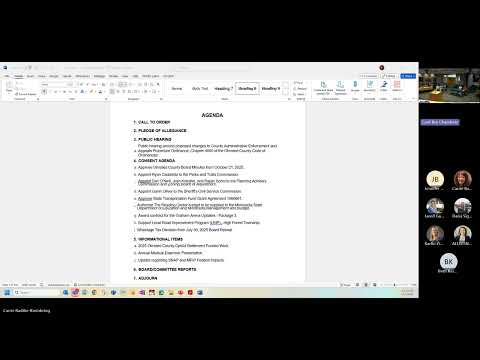
The Olmsted County Board of Commissioners on voice vote approved revisions to the County Administrative Enforcement and Appeals Procedures Ordinance (Chapter 4,000) after a public hearing that included questions about fee waivers, appeal routes and reapplication limits.
The Olmsted County Board of Commissioners on voice vote approved revisions to the County Administrative Enforcement and Appeals Procedures Ordinance, Chapter 4,000, following a staff presentation and questions from commissioners about fee waivers and appeal options.
Jenna Gilbertson, HHH, introduced the changes and said they largely update “old language, former department names” and include a proposed increase in the filing fee because “the current fee has not come close to covering the county costs.” Tom Canan of the County Attorney’s Office accompanied the presentation.
Commissioners asked how low‑income or indigent appellants could seek relief from the proposed filing fee; staff said the prior practice allowed an administrative official latitude to modify fees but that provision had not been used in recent years. Under the new draft, staff explained there is language permitting the fee to be split (half due up front and half due within 24 hours of the hearing) to ease the immediate burden for some appellants. A commissioner noted the county can still suspend an ordinance in rare circumstances.
Board members also questioned whether the old intermediate appeal route — an appeal from the hearing examiner to the county board — remained. Staff confirmed that under the revised ordinance appeals would proceed to court rather than to the county board, a change staff said reflects the use of a professionally trained hearing officer and a desire to create a stronger evidentiary record prior to any judicial review.
The changes also add a two‑year waiting period before a revoked permit may be reapplied for, a provision staff said is intended to prevent near‑identical reapplications that seek to circumvent an upheld revocation. Staff cited a recent example in license revocation and reapplication by a corporate name used to attempt immediate relicensure.
The board opened the public hearing and, after three calls for public comment with no speakers, closed the hearing and approved the ordinance revisions by motion and voice vote.
The ordinance revisions update procedural language, provide a payment‑split option for filing fees, remove the county board as an intermediate appellate forum, and add a two‑year reapplication restriction after certain permit revocations. The board did not provide a recorded roll‑call tally; the action carried on voice vote.