Get Full Government Meeting Transcripts, Videos, & Alerts Forever!
Get email alerts on the Special Education topic
No spam. Unsubscribe anytime.
Baltimore City Public Schools outlines plan to expand inclusion, cites gap with state LRE targets
Summary
Baltimore City Public Schools’ Special Education leadership told the Teaching and Learning Committee on Feb. 4 that the district is prioritizing movement of students with disabilities into less‑restrictive educational settings and increasing oversight of placements made outside the district.
Baltimore City Public Schools’ Special Education leadership told the Teaching and Learning Committee on Feb. 4 that the district is prioritizing movement of students with disabilities into less‑restrictive educational settings and increasing oversight of placements made outside the district.
"It is mandated that schools provide a continuum of services to ensure that each of our students with a disability is educated in the least appropriate to the individual needs," Lori Lynn Sutton, Executive Director for Special Education, told the committee as she reviewed the district’s continuum from LRE A (least restrictive) to LRE G (most restrictive) and the role of non‑public placements.
Why it matters: Sutton said the district currently identifies 15.2% of students as having disabilities and reported that about 61.9% of those students are served in LRE A — short of the Maryland State Department of Education (MSDE) target of 71.5% for LRE A placements. Sutton noted that approximately 117 students have moved from more‑restrictive placements into LRE A since the start of the school year, and she described increasing inclusion as a priority for the office.
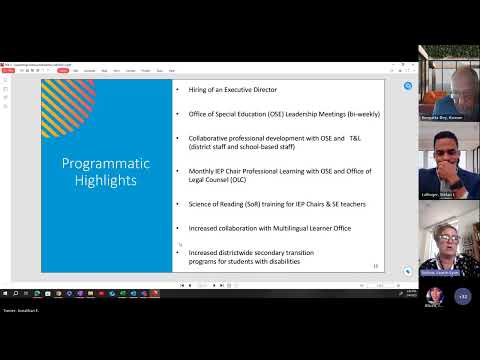
What the district is doing: Sutton outlined several programmatic steps intended to drive further inclusion: hiring an executive director for special education, monthly professional learning for IEP chairs to support compliance and consistent practice, science‑of‑reading training for literacy, expanded collaboration with the Multilingual Learners office, and an upcoming professional learning series on strategies to support students with autism. She also said the district is introducing Goalbook to help teachers write higher‑quality, standards‑aligned IEP goals.
Non‑public placements and partnerships: Sutton described non‑public schools as specialized placements that fall under the most restrictive LRE category and said the district has seen a steady decrease in non‑public enrollment as it strengthens in‑district supports. She said Baltimore City Public Schools partners with about 28 non‑public schools statewide and highlighted partnerships with Villa Maria, RICA and Children’s Guild for diagnostic services and short‑term therapeutic placements.
Funding and oversight: The presentation noted the district’s responsibility to provide a free and appropriate public education (FAPE) for placed students and said the district has a dedicated non‑public team to monitor instruction and services in those placements.
Questions and follow up: Commissioners requested the complete LRE distribution numbers (beyond the LRE A figure) and Sutton said she would provide the most recent counts and targets. No formal action or vote occurred; procurement and other agenda items were deferred to the full board meeting schedule.
Looking ahead: Special Education staff said they are planning cross‑office professional learning and continued use of grant and district funds to support initiatives as federal emergency funds (ESSER) and other streams change, and they emphasized continued planning during the district’s budget cycle.