Get Full Government Meeting Transcripts, Videos, & Alerts Forever!
Get email alerts on the Rural Protection topic
No spam. Unsubscribe anytime.
Commissioners tighten protections for rural lands, require clearer 'need' and proximity tests for amendments
Summary
Marion County commissioners directed staff to tighten comprehensive-plan protections for rural lands, to define objective tests for land-use conversions, and to remove a proposed cluster-density bonus adjacent to the urban growth boundary.
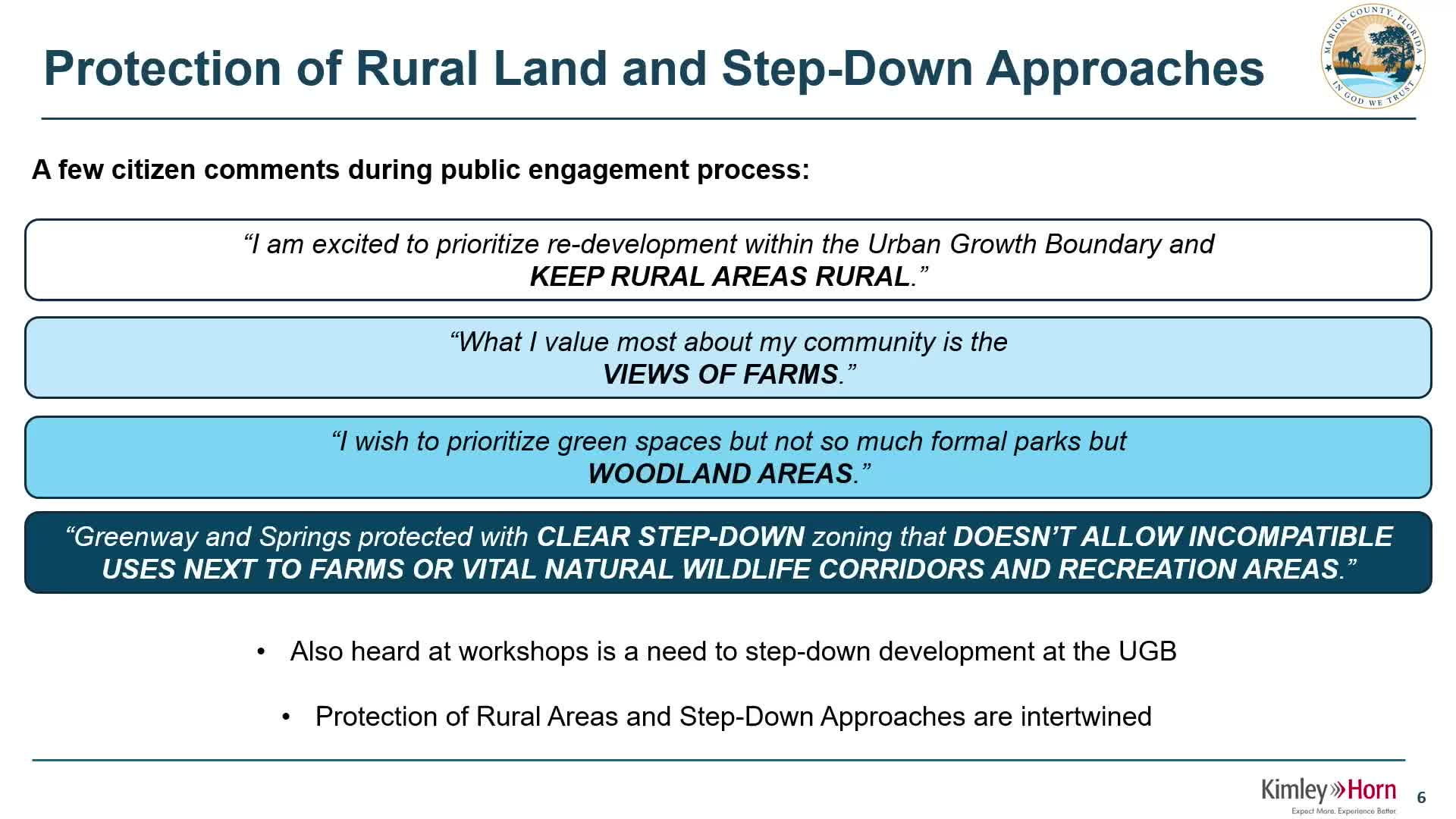
Marion County commissioners spent substantial time at a April 4, 2025 workshop refining proposed comprehensive-plan language intended to protect rural neighborhoods and set out step-down approaches where urban development abuts rural land.
Staff presented draft edits to the future land use element that would require applicants seeking to convert agricultural or rural lands to urban uses to "at a minimum" demonstrate: close proximity to the urban growth boundary (UGB), a demonstrated need for the amendment, compatibility with surrounding uses, and conformity with the land development code (LDC). Commissioners asked staff to supply clearer definitions and objective criteria for "close proximity" and for the content of a "need" analysis.
"We typically look for, is it adjacent or almost adjacent so that there's not a whole lot of leapfrogging," a planner said when asked what "close proximity" would mean in practice. Commissioners asked staff to return with a short checklist of items applicants must prove in a need analysis (for example: local jobs, housing support, trip generation impacts, and consistency with the county vision).
Step-down illustrative policy: staff presented an illustrative step-down approach that would require new development adjacent to the UGB to incorporate a one-hundred-foot setback/buffer, retain an existing natural vegetative buffer or provide a buffer meeting the LDC's opacity standards, and limit building heights at the buffer edge (example language gave 35 feet at the 100-foot edge, with incremental height increases moving into the development). Staff also proposed an optional cluster-density bonus tied to preserving at least 60% of an area as open space that directly protected rural lands.
Board response: several commissioners raised concerns that the proposed cluster-density bonus would allow apartment-scale intensity immediately adjacent to rural neighborhoods. After discussion, commissioners directed staff to remove the cluster-density bonus from the UGB-facing policy and instead explore density incentives farther inside the urban growth boundary.
Commissioners also requested that buffering rules be expressed in a way that produces reliable visual screening. One commissioner suggested using measurable opacity standards (for example, a required percentage of visual opacity within a given time frame) rather than prescribing specific plant species or sizes in the comp plan, and then rely on the LDC to spell out installation and growth specifications.
Utilities, package plants and rural development: commissioners asked whether privately owned wastewater systems (so-called package plants) would be allowed in rural areas. Staff said on-site treatment has been approved in limited cases where density and proximity to existing utilities made it appropriate; any such systems must meet county and DEP standards and, where the county adopts them, meet Marion County standards.
Next steps: staff was asked to redline comp plan language with a clearer definition of "close proximity," a short list of required elements for a needs analysis, and revised step-down buffer language that references opacity standards in the LDC rather than prescribing planting lists in the comp plan. Commissioners also asked staff to return with a map showing the UGB, adjacent land uses and existing zonings and a summary of items already allowed in agricultural areas to inform incentives for maintaining working farms.