Get Full Government Meeting Transcripts, Videos, & Alerts Forever!
Get email alerts on the School Transportation topic
No spam. Unsubscribe anytime.
School board shortens waiting period for using empty bus seats but debates 'day‑1' app idea
Summary
After extended debate, the Broward County School Board voted to amend policy PP2 to allow non‑eligible students to take open seats on buses after the first 15 school days (reduced from a proposed 20). Board members pressed staff for cost data, and councilors discussed a longer-term 'on‑demand' app concept to make unused seats available sooner.
A lengthy, often emotional discussion over district transportation policy centered on how to use empty seats on school buses and whether the system should be opened to additional students earlier.
Dr. Zeman urged an aggressive, technology‑driven approach: “I joined this board because we said we were gonna be the best school district in the country,” he said, arguing that unused seats should be filled immediately and proposing a system — likened to ride‑share or ATM convenience — that would allow families to claim available seats.
Transportation director Rolando Alvarez provided preliminary counts and ballpark costs during the discussion: he reported roughly 3,450 students living between 1.9 and 1.99 miles from school, which he estimated could cost about $5.5 million to bus; he also gave a range for the 1.5–1.99‑mile band roughly estimated at $2.4 million. Alvarez and staff noted that routing, bus-seat assignments and state reimbursement rules complicate any immediate, district‑wide change.
A student speaker, Aviva of Hollywood, urged the board to make empty seats available because parents’ work schedules and transportation barriers can prevent students from getting to school. Board members and staff discussed the operational tradeoffs: seats assigned based on summer registration may go unused the first week, and opening unused seats immediately risks displacing students who have registered and would be counted for funding and routing purposes.
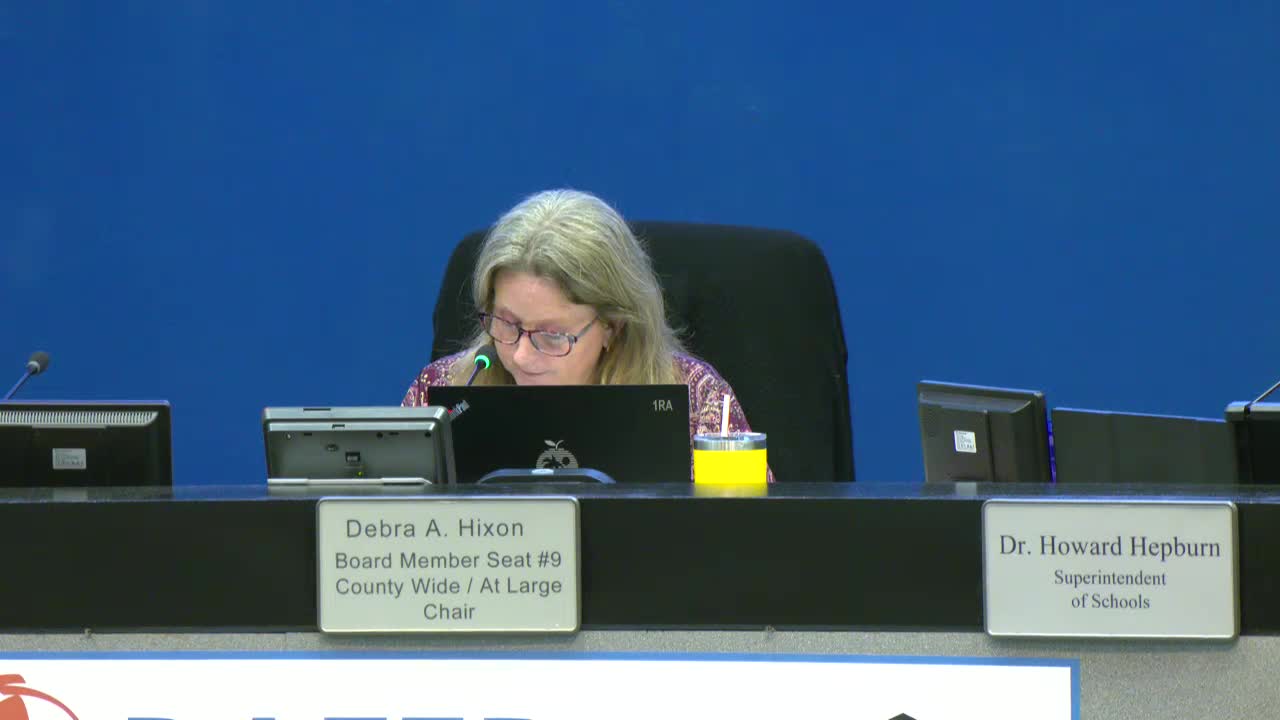
Madam Chair proposed a compromise amendment to the draft policy: change the post‑settlement waiting period from 20 school days to 15 school days. That amendment was seconded and passed; the board approved the policy as amended with one dissenting vote. Members asked staff for follow‑up data, including granular counts and cost estimates for targeted distance bands and whether the district’s existing transportation vendor or app provider could support a near‑real‑time seat‑availability system.
What the board approved
The board approved PP2 as amended to shorten the waiting period after which non‑eligible students may request open seats from 20 to 15 school days. The motion left routing, reimbursement, and precise implementation mechanisms to staff; board members requested a follow‑up workshop and additional financial data.
Provenance
Topic introduction excerpt (transcript block 180): “I have a motion. This is important. I cannot explain to my neighbors, why buses drive past kids that need a ride to school with empty seats.”
Student public comment excerpt (transcript block 286): “Some parents work multiple jobs. It is hard. You can't always take your kid in the morning. Traffic is insane and being late to your work could cost you your job.”