Get Full Government Meeting Transcripts, Videos, & Alerts Forever!
Get email alerts on the Downtown Office To Residential topic
No spam. Unsubscribe anytime.
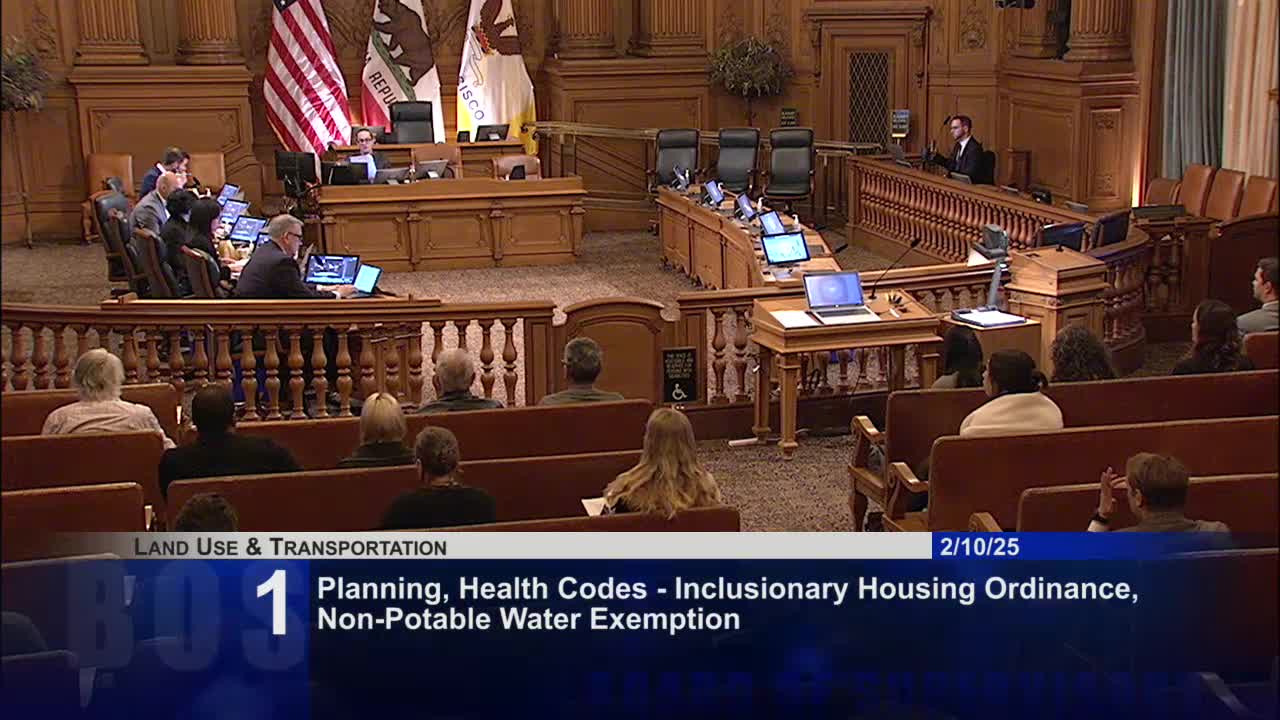
Committee sends downtown conversion fee waiver to Board as amended after heated debate
Summary
The Land Use and Transportation Committee voted Feb. 10 to recommend, as amended, an ordinance to waive certain development impact fees and inclusionary housing requirements for qualifying downtown commercial‑to‑residential conversions, a step sponsors said is needed to catalyze housing production and downtown recovery.
The Land Use and Transportation Committee on Feb. 10 sent to the Board of Supervisors, as amended, an ordinance designed to incentivize adaptive reuse of underutilized downtown office and commercial buildings by waiving certain development impact fees and inclusionary housing requirements for qualifying commercial‑to‑residential conversions in core downtown zoning districts (C2 and C3).
Sponsor Supervisor Matt Dorsey framed the legislation as part of “deep downtown recovery,” noting a historically high office vacancy rate and a “regional housing needs allocation” (RHNA) target the city must meet. Dorsey said conversions can both produce housing and reduce vacant office supply, helping stabilize the city’s tax base. He proposed non‑substantive cleanup amendments and a reporting requirement to the Inclusionary Housing Technical Advisory Committee; Supervisor Nannie Sauter, a co‑sponsor, said conversions would “activate a block” and benefit small businesses and transit.
Public comment spanned a wide range of positions. Supporters — including the San Francisco Chamber of Commerce, developers, construction unions, SPUR and architects — argued the city must adjust local policy levers to make projects financially feasible amid high construction costs, higher interest rates and low rents. Labor speakers urged inclusion of strong labor standards (prevailing wage, health care, training) in any program that produces construction work. Opponents — led by community groups representing South of Market, cultural districts and priority equity geographies — asked that cultural districts and priority equity geographies be excluded from the waiver, warning that removing impact fees would reduce funding for parks, childcare, schools and community infrastructure and risk displacement of existing residents.
Vice Chair Cheyenne Chen moved to continue the item to Feb. 24; the motion failed on roll call (Chen voted yes; Mahmood and Melgar voted no). Supervisor Bilal Mahmood later moved the amendments that had been circulated by Supervisor Dorsey; the committee adopted those amendments (roll call: 3 ayes). On the final question, the committee recommended the ordinance to the full Board as amended by a 2–1 vote (Chen recorded the dissent). Committee members said the changes were intended to be limited and time‑bound; opponents said the carve‑outs for priority equity geographies were insufficient.
What it does and limits: Committee discussion and the sponsor clarified that the waiver applies only to the square footage being converted from nonresidential to residential; any new additional residential square footage beyond the converted area would be subject to existing inclusionary and fee requirements. Planning staff said the Planning Commission recommended aligning gross floor area definitions, extending a pipeline date to April 1 and asking the inclusionary TAC to study impacts.
Votes and next steps: Committee adopted the amendments and recommended the ordinance as amended to the Board of Supervisors. The Board will receive the ordinance, the committee packet includes CEQA and planning consistency findings and the Planning Commission record. The committee directed departments to continue outreach and the inclusionary TAC reporting called for in the amendments.
Notable quotes: Supervisor Dorsey said conversions are key “to address 1 of the key strategies for downtown and citywide economic recovery.” A South of Market advocate asked, “How many more giveaways do developers need before they start actually building housing?” Planning staff clarified that a conversion or demolition/rebuild where the residential square footage replaces nonresidential square footage would be eligible for the waiver, but entirely new additional housing beyond the converted square footage would not be exempt.