Get Full Government Meeting Transcripts, Videos, & Alerts Forever!
Get email alerts on the Library Materials topic
No spam. Unsubscribe anytime.
Blount County Schools board forms library policy committee after demo of AI screening tool
Summary
Following demonstrations of an AI-assisted screening tool to triage district library inventories against the Age Appropriate Materials Act, the Blount County School Board voted to create an ad hoc library policy committee to review collection-review procedures and coordinate any districtwide rollout.
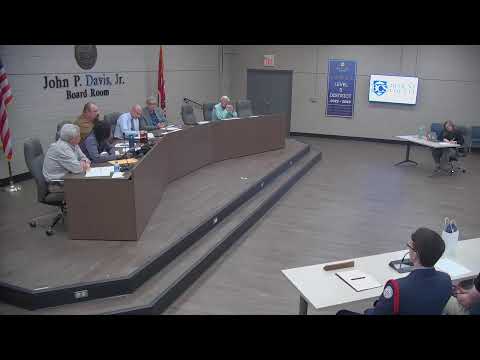
Blount County School Board members on Tuesday approved creation of an ad hoc library policy committee after administrators demonstrated an AI-assisted screening tool designed to flag library titles for human review under the Age Appropriate Materials Act.
Administrators and school staff showed the board an automated review platform built by William Blunt High School principal Derek Crabtree that ingests district policy documents, classroom inventory procedures, the districts collection-development plan and the state law to produce five outputs for each title: a brief summary, an age and maturity analysis, an assessment of educational mission, a compliance check and a final recommendation. Crabtree said the system produces a preliminary result in minutes and is intended to triage large inventories for librarians and principals to review.
"We ran a report earlier today. We have over 210,000 books in our Destiny system districtwide," Crabtree told the board, explaining why an automated triage could reduce hours of manual review. Crabtree ran two examples in the pilot: Johnny Tremaine, which the program marked approved, and Stephen Kings Pet Sematary, which the tool flagged as "requires further review." He emphasized the platform does not replace librarians but provides consistent, objective first-pass reviews.
Rockford Elementary librarian Jennifer Walker told the board she follows a multi-step, professional selection and weeding process that includes circulation data, award lists and multiple professional reviews. She said Rockford serves about 405 students, roughly 20 percent of whom live in households where English is not the first language, and that she has secured more than $12,000 in grants for her library. Walker described using the AI tool to triage difficult or borderline titles and said it saved hours of work.
Board members debated next steps: some pushed to refer a districtwide rollout to Mr. John Young and administrators for rapid deployment, while others said the district should form an ad hoc library policy committee to review and, if needed, clarify board policy and procedures before full implementation. At least one member pointed to recent findings of books that the districts legal counsel said violated the Age Appropriate Materials Act and urged a process that protects students while remaining transparent.
After discussion and procedural debate over a referral motion, the board voted by roll call to form an ad hoc library policy committee made up of principals, teachers, librarians, community stakeholders and board members to examine the collection-review process, suggest policy clarifications, and coordinate with the pilot program as it is tested at school sites.
Board members and administrators said the tool is already being piloted at William Blunt and that the platform can accept an entire inventory spreadsheet and flag titles for human review. Administrators noted that some aspects of the platform rely on commercially available AI (the presentation referenced a ChatGPT-based implementation) and that sharing the created GPT link currently allows staff to use the tool without additional cost; premium or alternate platforms may be explored later.
The board directed staff to proceed with committee formation and to provide principals and librarians access to the tool for pilot testing while the committee examines policy language and rollout logistics. The committee will be charged with recommending policy updates or procedures needed to support any broader adoption and to ensure compliance with state law.
"This isnt a tool that replaces the job of our media specialists and librarians," Crabtree said. "Its a resource that can support what they do, efficiently and consistently."