Get Full Government Meeting Transcripts, Videos, & Alerts Forever!
Get email alerts on the School Based Behavioral Health topic
No spam. Unsubscribe anytime.
Advocates and school leaders press DBH to fix school‑based behavioral health funding and staffing
Summary
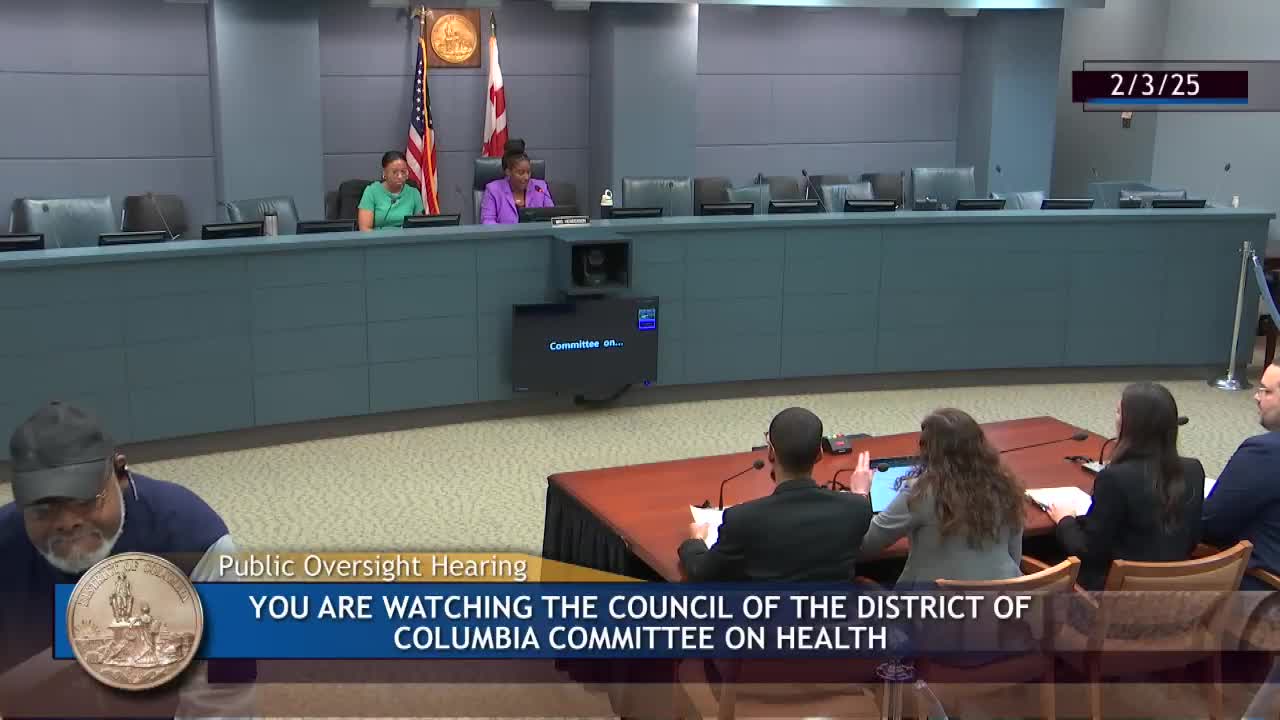
Chair Christina Henderson convened testimony Feb. 3 as part of a two‑part performance oversight review of the Department of Behavioral Health (DBH). Parents, educators, charter and district school leaders and community‑based providers told the Committee on Health the city’s school‑based behavioral health expansion is producing visible benefits where clinicians are in place, but that staffing and payment problems are limiting access.
Chair Christina Henderson convened testimony Feb. 3 as part of a two‑part performance oversight review of the Department of Behavioral Health (DBH). Parents, educators, charter and district school leaders and community‑based providers told the Committee on Health the city’s school‑based behavioral health expansion is producing visible benefits where clinicians are in place, but that staffing and payment problems are limiting access.
School leaders and advocates said the DBH expansion program — which funds community‑based organizations (CBOs) to place clinicians in public and public charter schools — has increased services in many buildings but depends on a funding model that requires CBOs to bill Medicaid or other payers for a portion of costs. That blended model is leaving some providers unable to cover full costs. ‘‘CBOs are choosing to leave the program or they are reducing the number of schools they're in,’’ said Caroline Pryor of EmpowerED, summarizing practitioner feedback to the strengthening families coalition.
The Children’s Law Center told the committee that a separate but related children’s service, community‑based intervention (CBI), has declined in reach: DBH’s own utilization dashboard showed 198 children received CBI in FY24, a 19% drop from the prior year and a much larger decline since FY20. The center’s behavioral health analyst, Chris Gamble, urged DBH to clarify how it measures availability and wait lists for intensive youth services.
School leaders described wide differences across schools and LEAs in how behavioral health is organized. Some large campuses have integrated clinicians who are treated as school staff; smaller “micro” schools or preschools said they were too small to justify full‑time placements under current rules and asked for more flexible award timelines and grant sizes. ‘‘We have a coordinator role that is effectively unpaid and stacked onto other duties,’’ Caroline Pryor said. Multiple witnesses called for at least modest annual compensation for school behavioral health coordinators and for more technical assistance so coordinators can succeed.
Speakers including Scott Goldstein of EmpowerED and Momentum Residency founder Marissa Perella argued DBH must invest in workforce development and retention. Providers said younger clinicians are willing to do school work but need intensive supervision and peer cohorts. Momentum’s residency model — a two‑year cohort of clinicians with supervision and mentoring — was cited as a promising retention approach.
Several charter school leaders said the pilot grants worked when schools could hire clinicians quickly, but slow award letters and hiring delays undermined impact. Smaller LEAs asked DBH to adapt requirements so part‑time or shared clinician arrangements are possible and to reduce the time between award and onboarding. ‘‘When clinicians are in place, the benefit is clear; the problem is getting and keeping them,’’ said Peter Anderson of Washington Latin.
Why it matters: School‑based behavioral health is intended to meet children where they spend the most time; witnesses warned that pausing or rolling back investments would create setbacks for students already showing gains. Committee members signaled they will press DBH for more granular billing and placement data in part 2 of oversight, and for an interim plan to stabilize CBO funding while a longer‑term financial model is developed.
What’s next: Witnesses urged the Council to (1) ask DBH for a timeline to revise the funding model for the expansion program, (2) require clearer, publicly accessible data on clinician placement, wait lists and billing, and (3) support pipeline/frontline workforce strategies such as residency cohorts and cross‑jurisdictional licensing reciprocity.