Get Full Government Meeting Transcripts, Videos, & Alerts Forever!
Get email alerts on the Housing Policy Eha topic
No spam. Unsubscribe anytime.
City staff report 53% approval rate for projects in EHA grace period; dozens closed due to inactivity
Summary
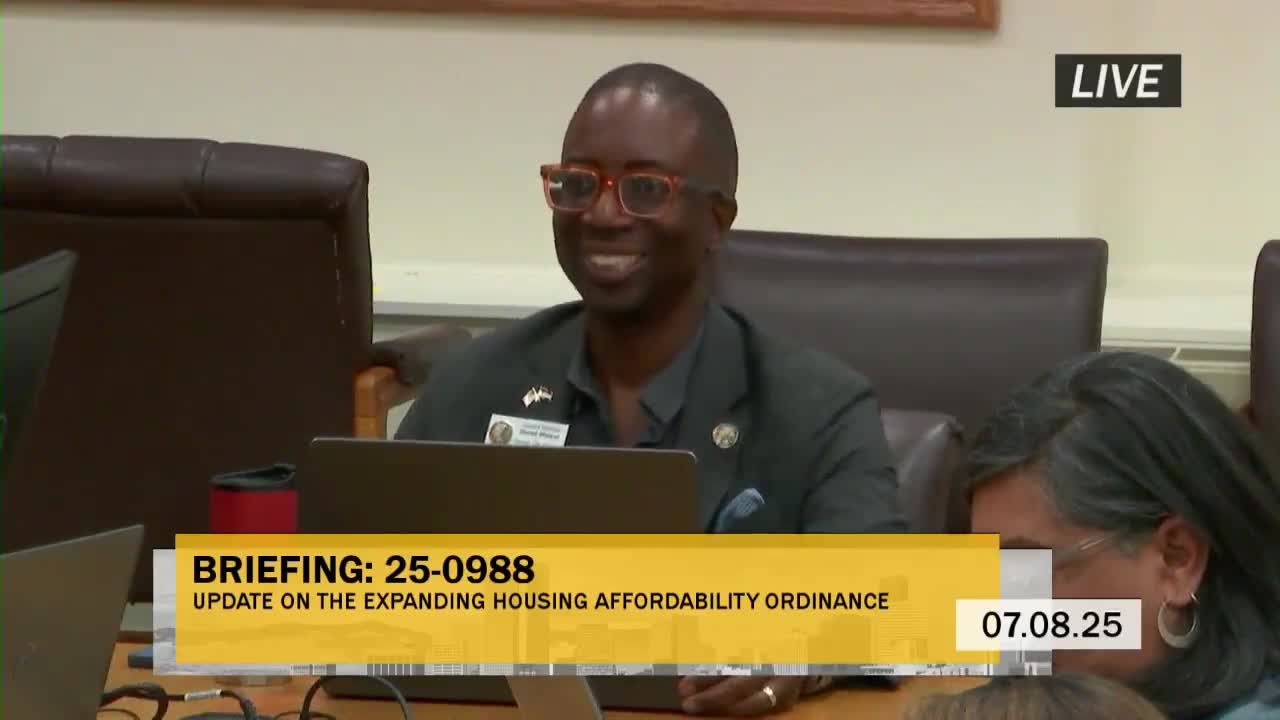
City planning staff and HOST reported July 8 that roughly 53% of projects eligible under the Expanding Housing Affordability grace period were approved; many other records were closed for inactivity and committee members asked staff for more detailed, district-level data and unit counts.
City planning staff and the Department of Housing Stability presented final outcomes July 8 for projects that sought to qualify under the Expanding Housing Affordability (EHA) grace period. Staff said the ordinance (effective July 1, 2022) requires projects with 10 or more units to provide on-site, income-restricted units or pay a fee in lieu; projects that submitted concept applications before June 30, 2022 could qualify for earlier review deadlines under the grace-period rules.
Emily (presentation staff) summarized outreach and process steps: city staff issued informational notices in April 2024, conducted a Planning Board hearing in June, and — to clear the remaining queue — used monthly then weekly email outreach, phone contacts, and targeted "focus weeks" to prioritize pre-EHA projects in review. Staff reported they started with "over 1,500 records" and described an overall status that included records approved, records closed due to inactivity, and other closed or withdrawn items.
Staff reported a 53% approval rate for the pool of eligible projects, and in discussion provided several figures: at one point staff said there were "628 records" approved in the overview and later discussed "635 site development plans" as a relevant approved count. Staff also said 10 projects did not meet the final deadline (their site-development plans did not receive final city signatures) and that approximately 46% of projects closed due to inactivity; staff cited 225 concept applications that did not move forward and 464 site development plans that closed for inactivity or were withdrawn. Committee members asked staff to reconcile counts and to provide district-level breakdowns and unit totals.
Chris Gleisner, director for Site Design and Neighborhood Development at CPD, told the committee his team typically staffs seven project coordinators and was at six during part of the review; he said staff completed the work without refilling one vacancy. Liah Mitchell of the Department of Housing Stability (HOST) said the grace-period close means the city is entering full policy implementation: HOST is improving internal tracking forms, coordinating compliance workflows and counting units under approved site-specific affordable-housing plans. HOST staff said there are 38 affordable-housing plans in process (which staff estimated would account for roughly 400 units in total) and five high-impact development compliance plans in process. Staff reported three fully signed high-impact compliance plans to date.
Councilmembers asked additional data and asked staff to map where projects closed and whether projects are paying the fee in lieu or building on-site affordable units. Staff said only a handful (staff characterized as "two") of projects had elected fee-in-lieu as their compliance option and that those projects had not yet paid the fee. Members also discussed market factors — rising interest rates and construction costs — as likely contributors to projects pausing or withdrawing, and staff agreed further analysis and survey data could help distinguish market effects from policy impacts.
Councilmembers requested further deliverables: district-by-district counts of approvals and cancellations, unit totals for approved site development plans, reasons applicants did not proceed (survey or outreach), and ongoing tracking of building permits to determine how many approved site development plans move to construction and occupancy.