Get Full Government Meeting Transcripts, Videos, & Alerts Forever!
Get email alerts on the Hughes Property topic
No spam. Unsubscribe anytime.
Council weighs civic-assembly recommendations for Hughes property; asks staff to clarify acreage, indigenous consultation and uses
Summary
City staff presented a draft resolution translating Civic Assembly recommendations for the 165-acre Hughes property into site parameters and asked council for guidance on acreage caps, indigenous consultation and whether certain recommended uses (for example, wildlife rehabilitation and a bike park) should be described as mandatory or optional.
Staff presented a draft resolution aimed at implementing the Civic Assembly's recommendations for the 165-acre Hughes property and asked council for direction on next steps and ballot timing. Assistant City Manager Rupa Venkatesh said the draft resolution would: require consultation with indigenous communities during site development; specify a naturalistic site character; designate up to 60 acres to natural areas; and designate the remainder as parkland managed by the Parks Department. The draft also proposed a limit of up to 35 acres for bike-park features (not including restrooms, shade or parking) and proposed up to 20 acres for an environmental-education partnership.
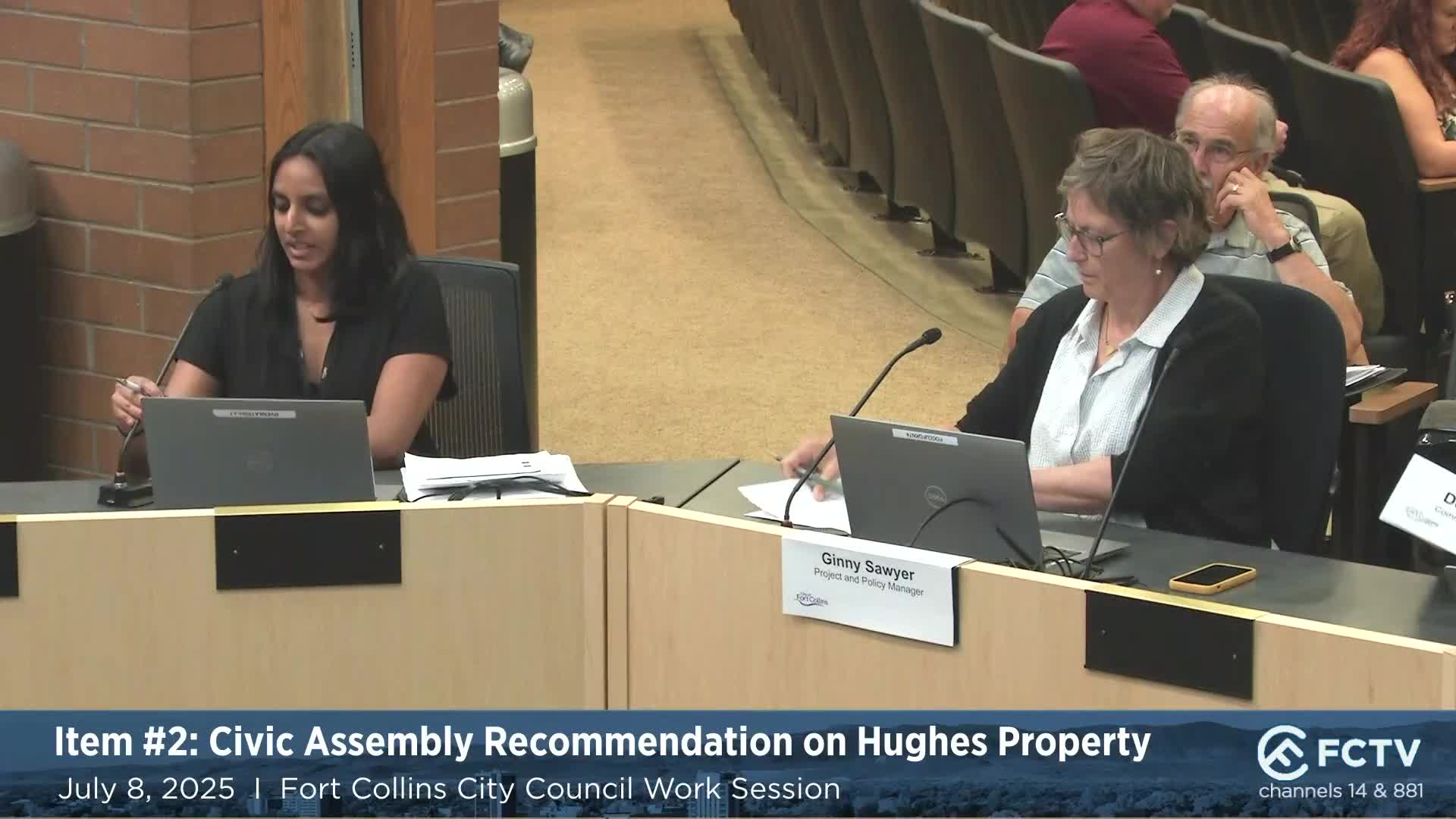
Venkatesh said the resolution language aims to translate the Civic Assembly's majority recommendations while remaining flexible about partnerships and future facilities. She described the drafting approach as nonprescriptive: "These uses are not required to include all these things, but they can include these things," she said. Councilmembers pressed staff for clarification on acreage math, the meaning of "permits and structures," and how permanent buildings and partner leases would be governed. Ginny Sawyer and Dean Kligner explained that future partner uses would be addressed by standard contracts, leases, and intergovernmental agreements and that council would be involved in any major ownership or long-term commitments.
Several councilmembers asked staff to keep the Civic Assembly's wording and intent close to the original recommendations. Councilmember Emily asked staff to add explicit reference to wildlife rehabilitation and wildlife-hospital facilities after locating the Civic Assembly's report showing "multi use" (including bike park, open spaces, trails, conservation and education) had 89% support. Councilmember Kelly pressed for more detail about the bike-park acreage cap and how staff compared Valmont (Boulder's 40-acre site) to the proposed 35-acre cap, asking whether the 35 acres included parking and buildings. Staff said Valmont's full site is about 40 acres and includes parking and ancillary facilities, and that the 35-acre cap for bike features was intended to enable a community-scale bike park without guaranteeing that exact size.
Council also discussed procedure: staff said the draft resolution could be adopted by council and referred to the ballot for voter decision; staff noted that an existing citizen initiative that qualifies for the ballot would supersede a council resolution if that initiative passes. Council requests for the resolution draft included: clarify open-space terminology versus natural areas; include wildlife rehabilitation in environmental-education language; consider raising the education-partnership cap to 30 acres to accommodate potential partners; provide more precise acreage breakdowns for disc golf and stormwater detention; clarify that the 20-acre limit is for the entire environmental-education opportunity (not building footprint); and provide illustrative acreage maps to show how uses could fit within the 165-acre site. Staff said it would return to a regular meeting (proposed August 19) with a revised draft resolution and additional supporting details.