Get Full Government Meeting Transcripts, Videos, & Alerts Forever!
Get email alerts on the Street Improvement topic
No spam. Unsubscribe anytime.
South Pasadena updates SB1 spending and slurry program; City Council-awarded $6.885M street contract to Gentry Brothers
Summary
City public works staff updated the Public Works Infrastructure Commission July 9 on state SB1 funding, a completed five-mile slurry-seal program and the FY19-20 street improvement project; staff said City Council awarded the reconstruction contract to Gentry Brothers for $6,885,400 (a not-to-exceed $7,589,040 with contingency).
Staff briefed the City of South Pasadena Public Works Infrastructure Commission on July 9 about state SB1 funding, a recently completed slurry-seal campaign and the larger FY19-20 street improvement project that City Council awarded June 18.
Michael, Public Works staff, told commissioners that SB1 (a state gas-tax funding program) requires a maintenance-of-effort and that "our maintenance of effort is approximately $1,400,000 per year. And, if we meet that maintenance of effort, South Pasadena receives approximately $700,000 a year. So in fiscal year 25 26, we're slated to receive $704,838." He said the city reached roughly $654,068 from SB1 in FY23-24 and that the annual amount varies.
Staff said the city completed a slurry-seal operation covering about five miles of streets using the new zone approach (purple, orange and pink zones in this cycle). The operation included crack sealing, weed abatement, localized dig-outs and replacement of damaged curb and gutter where required; staff reported approximately 9,000 square feet of dig-outs within the five-mile network. According to staff, thermoplastic striping, stop legends and some sign replacements were being finished at the time of the meeting.
On the FY19-20 street improvement project (a larger reconstruction program that includes asphalt, concrete, water-line replacement, streetlight upgrades and limited sewer repairs), staff said the city advertised on PlanetBids and opened bids on June 9. The engineers' estimate was about $7.6 million. The low responsive bidder was Gentry Brothers at $6,885,400. "With Gentry Brothers being awarded the project for $6,885,400 and a contingency of approximately 10%, the contract will be for a not-to-exceed amount of $7,589,040," staff reported.
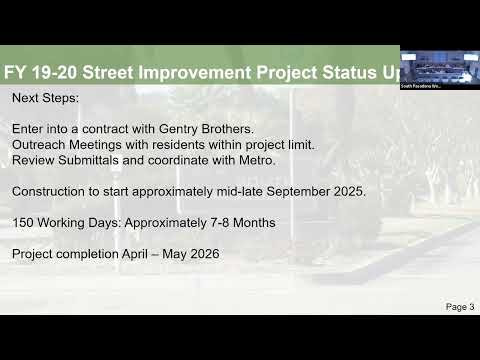
Staff outlined the funding plan: about $3.0 million from general fund and local measures (fund 104, measures 233 and 236, and SB1 fund 237) to cover asphalt, concrete, streetlight and striping components; approximately $3.9 million budgeted from the water enterprise fund (500) for water-main work; and a roughly $25,000 sewer repair to be charged to the sewer enterprise fund (210). Staff said Gentry Brothers must submit bonds and sign the city's standard contract, followed by a pre-construction meeting and coordination with Metro for work on Arroyo Verde. Outreach to residents in project limits is planned in mid-August; construction was expected to begin mid- to late September and run for about 150 working days (roughly seven to eight months when staged).
Commissioners pressed staff on how streets are prioritized for SB1 and other funding. Staff said the city must adopt by resolution the streets it plans to use SB1 funds on and report those expenditures; the pavement-management plan and prior design work shaped the FY19-20 project list, while the city is moving to a zone-based approach for future cycles. Staff committed to bringing 30% and 60% design milestones back to the commission for projects entering design so commissioners can review elements such as parking, bike lanes and curb adjustments.
Commissioners and staff also discussed practical opportunities to refresh striping and crosswalks while contractors are mobilized for slurry or other projects. Staff said the city is pursuing on-call contracts for routine striping and sewer repairs so smaller needs can be addressed between major CIP projects.
Staff noted typical slurry-seal life at seven to ten years and confirmed in-house inspection of the slurry work with photo documentation and quantity checks; staff also said it expects to finish the remaining zone slurry program next summer using combined fiscal-year allocations.
Ending: Staff said the Gentry Brothers contract is moving through bonding and contract execution steps and reiterated that outreach and a pre-construction meeting are planned before work begins. Commissioners signaled interest in early design reviews for upcoming zone projects and in using mobilized crews to refresh striping in nearby corridors.