Get Full Government Meeting Transcripts, Videos, & Alerts Forever!
Get email alerts on the Artificial Intelligence topic
No spam. Unsubscribe anytime.
Tewksbury school committee adopts district guidance on artificial intelligence, links it to handbooks
Summary
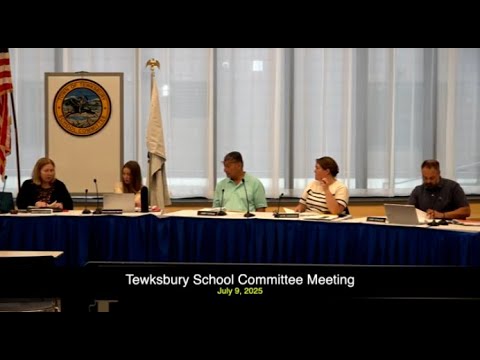
After a presentation from the district STEM and IT director, the Tewksbury School Committee voted unanimously July 9 to approve guidance on the appropriate and responsible use of generative artificial intelligence and to link that guidance to the district's acceptable-use procedures and student handbooks.
The Tewksbury School Committee voted unanimously on July 9 to adopt district guidance on the appropriate and responsible use of artificial intelligence, urging staff and students to use AI tools to support learning while preserving academic integrity.
Jason Stamp, the district's STEM and IT director, presented the guidance and said it is grounded in seven principles meant to center student achievement, compliance with privacy rules, development of AI literacy, and human oversight. "AI should support our decisions, not make them for us," Stamp said, summarizing a guiding principle in the document.
Stamp told the committee the district has been building toward this guidance since late 2022, combining pilot teacher use, data-privacy agreements (DPAs) and professional development. He said the district will generally require DPAs before students use third-party AI tools and that, where necessary because of age restrictions, teachers will act as the logged-in user so students can interact with AI under adult supervision.
Committee members asked how the district will identify academic integrity breaches and how families will be informed. Stamp said tools exist to help detect suspicious submissions but emphasized teachers' evolving assessment practices, baseline writing samples (such as summer reading assignments) and citation requirements as practical safeguards. He said the guidance will be a living document and the district plans ongoing training for staff, students and families.
The motion to approve the guidance was made by school committee member Biajoni Smith and seconded by Mr. Moncada; a separate motion to place the item out of order was moved and approved earlier in the meeting. The committee approved the guidance "as presented," and district leaders will link the document to the acceptable-use procedures and the student handbooks.
The guidance does not replace policy, Stamp and administrators said; rather, it is intended to be a flexible, updateable set of procedures that can be revised as technologies and legal requirements evolve. The approved guidance will be used to inform teacher PD this fall and to shape student-facing digital literacy lessons.