Get Full Government Meeting Transcripts, Videos, & Alerts Forever!
Get email alerts on the Policy And Governance topic
No spam. Unsubscribe anytime.
Public pushes back as board advances policy revisions on controversial issues, philosophy and religion
Summary
Residents and parents objected at the Hunterdon Central board meeting to proposed revisions to policies addressing the district’s philosophy, controversial issues and religion in schools, saying the changes remove anti‑bias language and unduly constrain classroom discussion.
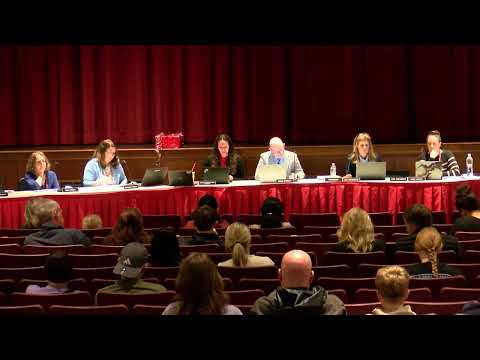
A package of policy updates that included revisions to 2110 (philosophy), 2240 (controversial issues) and 2270 (religion in schools) prompted sustained public comment and divided votes at Monday’s meeting of the Hunterdon Central Regional Fiscal Board of Education.
Multiple residents urged the board to reject the revisions during both action‑item and general public comment periods. Raritan Township resident Ted Hoff told the board he was “more concerned” after re‑reading policy 2240 and said current proposed language would prevent teachers from teaching students how to evaluate competing theories. Hoff warned the policy as drafted could leave students unable to distinguish demonstrably false claims and cited Holocaust denial and The Bell Curve as examples he said illustrated the risk of leaving controversial questions as merely “the teacher’s opinion.” He also asked the board to explain an increase in reported legal fees from $75,000 to $125,000.
Parent Christina Leah asked the board to vote no on the second readings, arguing the changes remove explicit board statements that “racism, prejudice, and bias are unacceptable” and leave teachers and students without clear guardrails for instruction. She and other speakers said the board’s newsletter explanations did not answer community concerns about deletions and newly proposed restrictions requiring approval for topics outside course curriculum.
Reverend Vernon Williams and other residents urged more public involvement in policy changes and questioned the process; Williams also asked about possible conflicts related to attorney selection. Board members responded that they had cleared conflict‑of‑interest questions with counsel.
During the policy committee readout, the chair said policy updates were administrative in many sections but acknowledged members had requested extra review of discretionary language. The committee moved several policies for board action, noting the counseling services policy (2411) appears as a first read and that policy 2435 (NJSIAA random testing) is required by association membership.
When the board took the roll call vote, the motions passed by majority. Several board members recorded no votes on specific policies during the roll call; the meeting minutes record multiple individual no votes and recusals on parts of the package, though the overall motions carried. The motion to adopt the listed second readings was recorded as passed.
Board members and the superintendent said some changes were vendor or statute‑driven and that additional administrative language would be incorporated into handbooks or regulations where applicable. Board members who opposed parts of the package said they wanted to preserve stronger language in the district’s philosophy and counseling statements.
What happened
- Public commenters urged the board to reject or substantially revise the policy language, citing concerns that deletion of explicit anti‑bias language and restrictions on controversial topic discussion would harm students and teachers. - The policy package advanced by majority vote; individual board members recorded no votes on certain items and several recusals were logged in committee votes.
Why it matters
Board policy sets the expectations teachers use to design lessons and manage classroom discussion; language that narrows how controversial topics are taught can shape curriculum and teacher practice across the district. Several speakers asked for more public input before final action.
What’s next
The administration indicated counseling services and related implementation details will be incorporated into department handbooks and possible regulation revisions. Community members said they will continue to monitor the next policy cycle and consider the changes when voting in upcoming elections.