
Redistricting Study Commission presents 19 map scenarios; board discusses priorities and timeline
Get AI-powered insights, summaries, and transcripts
Sign Up Free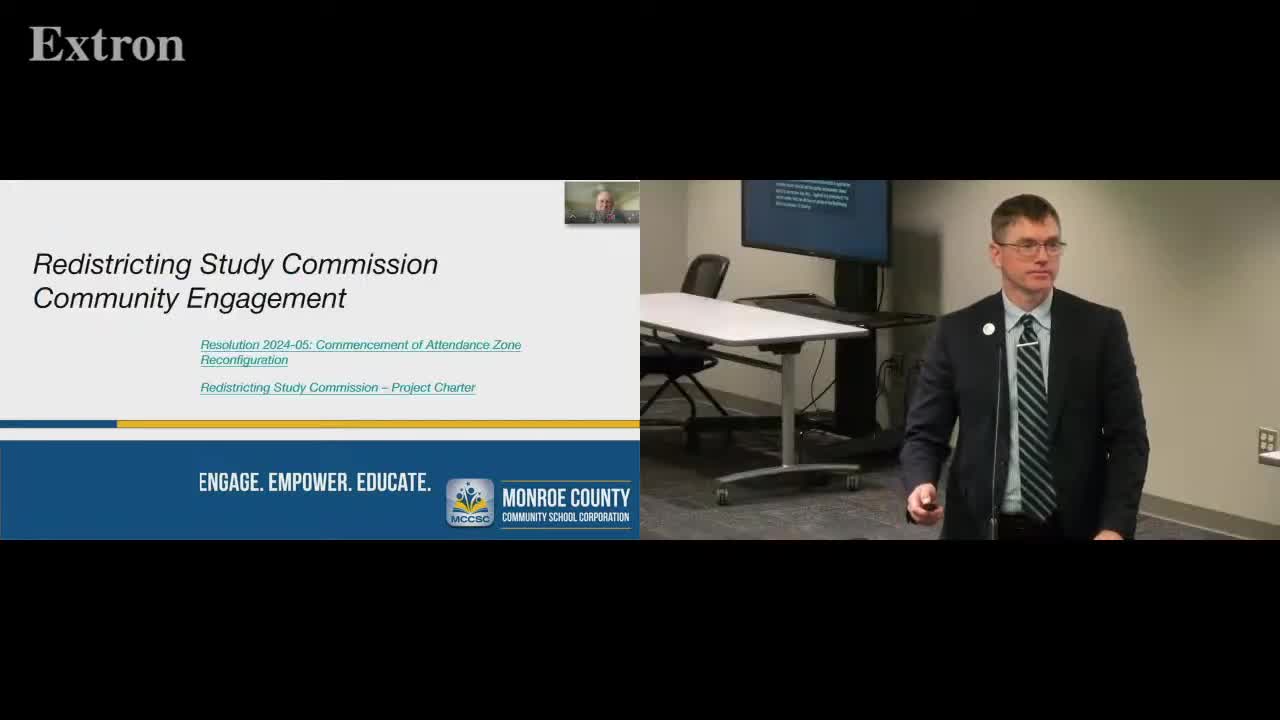
Summary
The Redistricting Study Commission told the Monroe County Community School Corporation board on July 8 that it has evaluated 19 redistricting scenarios and will refine the strongest maps this fall.
Doctor Tim Dowling presented an update on the Redistricting Study Commission, reporting that commission members have reviewed 19 maps across two phases and are using a rubric based on board priorities (balancing socioeconomic status and cost effectiveness) and community considerations (capacity, resource allocation/class size, student well-being/social-emotional needs, transportation and neighborhood schools).
Dowling said the commission analyzed maps from the district demographer and the district data team, including scenarios that would close one or two elementary schools, and that commissioners provided strengths, concerns and comments via a structured rubric. He said the commission's phase-two work included scenarios with two-school closures selected using five criteria: current and projected enrollment, current and projected utilization, building capacity, proximity, and school programming.
Board members asked detailed questions. Trustee Asia Jesser asked whether synchronous classes would be exclusively MCCSC students; Dowling said that depends on enrollment and could include students from other districts. Trustees asked how many community survey respondents there were (Dowling: 333) and how many commission members participate (Dowling: 92). Several trustees and the demographer noted that ordering the board's priorities (capacity vs. socioeconomic balance vs. cost effectiveness) will materially affect map outcomes; Trustee Erin Cooperman and others urged continued discussion of priority ordering given the district's evolving financial landscape.
Next steps: Dowling said the commission will focus on the top-scoring maps and refine them between now and meetings scheduled for Sept. 17, Oct. 22 and Nov. 5, with continued public engagement and commission feedback.