Get Full Government Meeting Transcripts, Videos, & Alerts Forever!
Get email alerts on the Parking Policy topic
No spam. Unsubscribe anytime.
Council advances amendments to Chapter 90 to revive permit parking, modernize parking payment rules and restrict vehicle habitation
Summary
The San Fernando City Council on July 8 advanced a package of Municipal Code revisions to Chapter 90 that would relaunch a petition‑based residential permit parking program, update city authority over paid parking devices and rates, and prohibit habitation in vehicles and overnight parking of recreational vehicles with a 30‑day outreach period before enforcement.
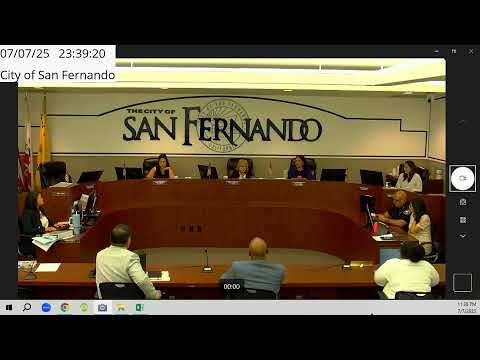
The city continued a public hearing on proposed amendments to Chapter 90 (Traffic and Vehicles) and advanced the ordinance for first reading on July 8.
What the ordinance would do: - Residential Permit Parking (RPP): Establish a petition‑based process for creating or dissolving RPP zones. The ordinance sets a baseline guideline that a proposed zone should be roughly 1,500 feet of street frontage (about four contiguous blocks) but delegates detailed rules (petition thresholds, block definitions, low‑income fee waivers, signage and enforcement rules) to administrative guidelines prepared by the public works director and reviewed by the Transportation & Public Safety Commission for council approval. - Parking payment devices and rates: Modernize municipal code language to cover pay stations, apps and other payment devices, and permit limited rate adjustments by the city manager or designee within small increments (staff proposed maximum 50¢ increase per fiscal year without council approval and 25¢ minimum incremental step) based on occupancy and fiscal analysis. - Restrictions on habitation in vehicles and RV overnight parking: Add clarifying language to allow police enforcement on habitation (defined by observable indicators), to prohibit RV and camper overnight parking on public streets between defined overnight hours (with short loading/unloading and active work exceptions), and to bar RV parking within 250 feet of schools except for permitted loading or construction work. Staff said an education/outreach period would precede enforcement for 30 days to connect people to services.
Council action and vote: Council advanced the ordinance for first reading (roll call: yes 3, no 1, absent 1). Councilmember Victoria Garcia voted no and requested that the forthcoming administrative guidelines explicitly list the exceptions (for example, near a border with another jurisdiction, cul‑de‑sac geometry) so petitioners and staff have clarity on when smaller, geographically constrained areas can qualify for RPP.
Enforcement and social‑services coordination: Police staff and social‑services staff told council they would use outreach and existing partnerships (North Valley Caring Services, Home Again LA) during the education period and that enforcement is intended as a last step. Council directed staff to ensure outreach contact records are shared with social‑service partners to track family referrals and avoid enforcement that separates families when alternatives exist.
Why this matters: The ordinance would give San Fernando a modern RPP toolkit and a mechanism for short‑term paid parking adjustments while giving police a clearer municipal code tool to address vehicle habitation and overnight RV parking. The details of thresholds, notices, low‑income fee waivers, and outreach will be set in administrative guidelines and returned to the Transportation & Public Safety Commission and council for approval before program rollout.
Next steps: Staff will draft and publish the administrative guidelines, begin outreach, re‑qualify existing RPP zones under the new rules, and return for a second reading and adoption. The new code language would take effect 30 days after final adoption.