Get Full Government Meeting Transcripts, Videos, & Alerts Forever!
Get email alerts on the Transit topic
No spam. Unsubscribe anytime.
Metro presents outreach and two alternatives for East San Fernando Valley shared right‑of‑way; safety and business impacts dominate local reaction
Summary
Metro staff told the San Fernando City Council on July 8 that community outreach shows broad interest in safer pedestrian crossings and a mobility hub; staff framed two alternatives — a 4‑track light‑rail build with heavier property and traffic impacts and a 2‑track Metrolink‑first approach with mobility‑hub improvements — and recommended early safety upgrades while a locally preferred alternative is decided.
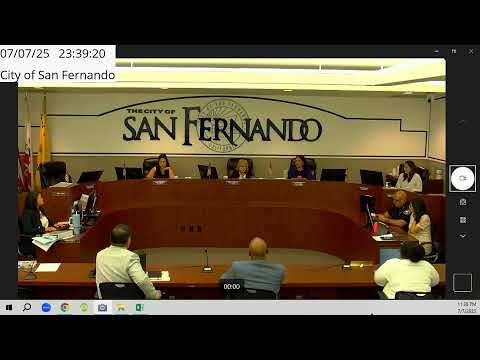
Metro presented results from public outreach on the East San Fernando Valley shared right‑of‑way study at the San Fernando City Council meeting on July 8, reporting in‑person engagement and a resource fair attended by about 150 people (roughly 90% Spanish‑speaking at that event).
Metro outlined two study scenarios. Scenario 1 is a 4‑track full build that would accommodate both light rail transit (LRT) and commuter rail through the right‑of‑way and could place a station near McLeay/Maclay; Metro staff said that in constrained sections of the corridor additional right‑of‑way and grade changes would be required and that an elevated or below‑grade station would be likely — causing substantial property and traffic impacts in narrow sections of the San Fernando corridor. Metro’s slide deck showed roughly 25 trains during peak periods for the 4‑track scheme (20 LRT + 4 Metrolink + 1 freight) in those peak hours.
Scenario 2 is a 2‑track approach focused on Metrolink improvements with an added mobility hub at Van Nuys Boulevard and San Fernando Road and upgraded bus and pedestrian connections. Under that scenario Metro showed about five trains during peak hours (4 Metrolink + 1 freight) through constrained corridor segments; Metro also showed conceptual safety and pedestrian mitigation measures, visible crosswalks, shade and seating, real‑time information and bike/multimodal amenities for mobility hubs.
Council questions and community input centered on three practical issues: (1) station siting and business takings under Scenario 1 (staff said Scenario 1 could require property takes in narrow sections and estimated 15–18 parcels might be affected in the San Fernando segment); (2) how Scenario 2 could be made to deliver community benefits (better bus shelters, microtransit, enhanced bus frequencies, shade, seating and art at hubs); and (3) near‑term safety improvements for existing crossings (Metro staff recommended “quiet‑zone‑ready” crossing upgrades including separate pedestrian gates and four‑gate crossing configurations). Metro said early “quick‑works” to improve crossings could be advanced on a shorter timeline than building track or stations and that they plan to bring a recommended locally preferred alternative to the Metro board this fall/winter.
Why this matters: The choice between a higher‑capacity light‑rail option that requires wider right‑of‑way and has greater station density versus a lower‑impact Metrolink modernizing option with mobility hubs will affect local property impacts, business displacement risk, pedestrian safety, and what kind of transit access the community will have for downtown and regional destinations.
Council response and next steps: Multiple councilmembers expressed skepticism about Scenario 1’s business and traffic impacts and indicated a preference for Scenario 2 if it can be paired with strong commitments for safety work, bus/service upgrades, local parking and wayfinding, and station‑adjacent public realm improvements. Metro said it would (a) present community and technical findings to the Valley Council of Governments and the Metro board in the fall/winter cycle; (b) draft a board report and consider whether to advance one or both alternatives into environmental study; and (c) coordinate on funding and early safety work if a locally preferred alternative is identified.
Sources: Metro presentation to San Fernando City Council, July 8, 2025; Q&A in council meeting.