Get Full Government Meeting Transcripts, Videos, & Alerts Forever!
Get email alerts on the Prop35 Workforce topic
No spam. Unsubscribe anytime.
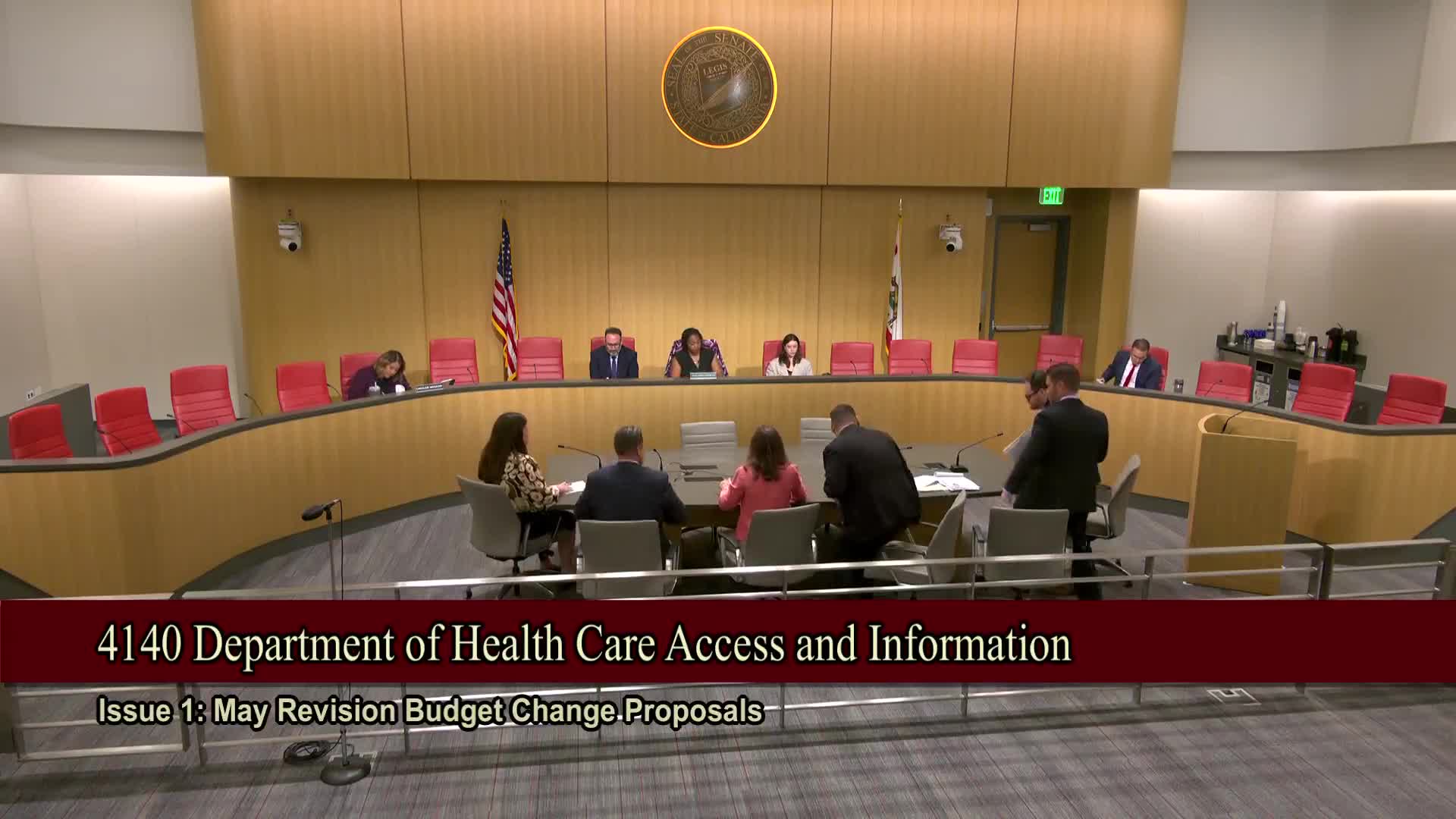
HCAI outlines Prop 35 spending plan, PBM data rules and midwifery, prompting questions over supplanted provider pay
Summary
HCAI told the Senate subcommittee that Prop 35 funding in the May Revision would prioritize new workforce investments, midwifery training and PBM data reporting rather than direct, ongoing provider rate increases.
The Department of Health Care Access and Information (HCAI) told the subcommittee it intends to use portions of Proposition 35 money for workforce development, midwifery education expansion and a labor‑management cooperative model rather than direct provider rate increases.
Libby Abbott, deputy director for health workforce development at HCAI, said the May Revision proposes allocating $90 million from Prop 35 for reproductive health services in calendar years 2025'026 and $75 million for Medi‑Cal workforce development programs (plus federal matching funds). Abbott told the committee the $75 million would seed labor‑management cooperation committees (LMCCs) to support training, apprenticeships, loan repayment and workforce capacity building.
“I would like to emphasize these are new dollars through the BH Connect waiver,” Abbott told the subcommittee, describing LMCCs as partnerships between employers and unions to fund training and career ladders. She said some of the reproductive health allocation would be used to expand midwifery education programs, where California faces capacity constraints.
Senator Menjivar and others pressed HCAI and the Department of Finance on whether Prop 35'allocated funds could be used to restore provider rate increases proposed to be cut elsewhere. Department of Finance staff and HCAI officials said a non‑supplementation clause limits spending that would directly replace provider rates already funded elsewhere, and that some uses of the $90 million are legally constrained. DOF staff said limited‑term workforce investments can be easier to match to the measure's language. The Legislative Analyst's Office asked for more detail on long‑run costs and the limits.
HCAI also described a multi‑part package to boost transparency around pharmacy benefit managers (PBMs), including requiring PBMs to submit granular drug‑pricing and rebate information to HCAI and moving from PBM registration to licensure enforced by the Department of Managed Health Care. Scott Chrisman of HCAI explained the proposal would require PBMs to report wholesale acquisition cost, pharmacy counts, rebates and contracts, grouped by national drug code and therapeutic category, to better understand and control drug pricing.
On other items, HCAI said it reduced the proposed ongoing budget for the Health Care Payments Database (HPD) from $22 million ongoing to $18 million one‑time in FY 2025'6 while it evaluates sustaining costs. The department also proposed positions and federal and state funds for the BH Connect waiver implementation and for the HPD expansion.
The Legislative Analyst's Office and several senators asked the administration to provide additional detail; LAO said major policy choices remain and proposed alternatives (for example, tiered premiums or varying eligibility rules for the undocumented population) that the legislature might consider.