Get Full Government Meeting Transcripts, Videos, & Alerts Forever!
Get email alerts on the Animal Control topic
No spam. Unsubscribe anytime.
Louisiana SPCA asks City Council for operating increase as animal intakes and costs rise
Summary
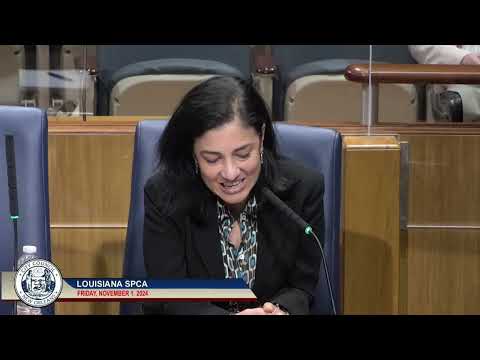
Anna Zurillo, CEO of the Louisiana SPCA, told the City Council the organization is seeking an operating increase tied to rising animal intakes, higher insurance and supply costs, and the need to retain and train field officers who enforce Chapter 18 of the municipal code.
Anna Zurillo, CEO of the Louisiana SPCA, told the City Council the organization is seeking an operating increase tied to several persistent pressures: a surge in puppies and sick or injured animals, higher insurance and consumables costs, and the need to retain and train field officers who enforce Chapter 18 of the municipal code.
Zurillo said the SPCA operates two legal entities: Louisiana SPCA, which focuses on promoting companion-animal welfare, and New Orleans Humane Law & Rescue, which holds the cooperative endeavor agreement to provide city-contracted animal-control services focused on public health and public safety. "Our first step is solving problems to keep people with their pets," she said, and added that enforcement (citations or impoundments under Chapter 18) follows only after education and resource provision.
Why it matters: Zurillo said average length of stay for animals has risen from a historical target of about 14 days to roughly 21—24 days this year, which increases daily operating costs and reduces throughput to adoption. She warned that the organization has been conservative in revenue projections after a decline in adoption revenue and has seen insurance costs rise because those costs are allocated by headcount across a larger staff.
Key budget drivers and clarifying details: Zurillo said the SPCA is asking for a recovery in operating funds that reflects two years without increases; she cited roughly a $715,000 cumulative gap that makes this request look larger than a single-year bump. She flagged three specific drivers: an estimated $30,000 decrease in adoption revenue compared with last year, substantially higher insurance costs tied to fleet operations and bite risk, and inflation for consumable medical and facility supplies. The SPCA reports full-time staff increased from 34 to 41 in the current year and that officers typically require six to 12 months of training to be fully competent for field work and court documentation.
Program changes and requests: To address operational needs, the SPCA proposal includes cost-of-living and merit adjustments to retain officers, adds a field officer manager, expands medical staffing to handle more sick or injured animals, and creates a full-time enrichment position to maintain animal welfare for longer stays. Zurillo asked council members to expect a draft of proposed ordinance revisions before the end of the year; the proposals will include raising rabies licensing fees (noted as unchanged for 11 years), clarifying animal-housing rules, and strengthening mechanisms for off-leash enforcement.
Council questions and discussion: Council members pressed on wildlife and emergent issues. Zurillo said New Orleans lacks a comprehensive wildlife plan and that removing coyotes can worsen the problem because coyotes live in family groups that refill vacated territories. She recommended cross-agency coordination with the stateWildlife & Fisheries and local partners. Zurillo also described a multistate CDC-collaborative project with New Orleans Mosquito, Termite and Rodent Control to address vector-borne disease messaging and to link animal-feeding behavior (for example, leaving cat food outdoors) with higher risks of rats, fleas, ticks and disease transmission.
Public-safety emphasis: Zurillo and council members emphasized off-leash dogs as a major health and safety issue. She stated that the department prioritizes dog attacks and rabies control under the city contract and noted that many serious incidents stem from dogs off leash or from unsecured yards. She urged more dog parks as alternatives for off-leash exercise and stronger enforcement mechanisms in any ordinance revisions. The presentation also covered neighborhood impacts from chickens (hens are legal; roosters are not), including noise, property trespass, and attraction of rats or predators.
Next steps: Zurillo said the SPCA will continue stakeholder outreach on ordinance changes and will provide a draft to council members for comment. She advised residents to route animal emergency and complaint reports through 311/911 so calls are recorded and agencies can track response metrics.