
Amarillo council hears case for property-tax break to shore up child care providers
Get AI-powered insights, summaries, and transcripts
Sign Up Free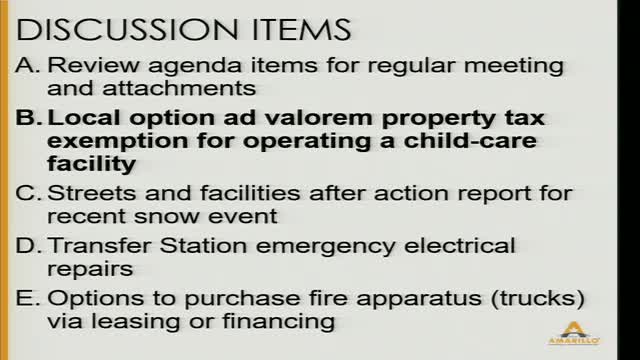
Summary
Skyler Gallup told the Amarillo City Council that adopting a state-backed property-tax exemption for licensed child-care providers would help stabilize 26 local programs, reduce pressure on wages and facilities and cost the city an estimated $28,000 at full abatement.
Skyler Gallup, representing Early Matters Texas Panhandle, urged the Amarillo City Council to adopt Prop 2, a state constitutional property-tax exemption for child-care providers, arguing the move would stabilize providers and support the local workforce. “By adopting Prop 2 and providing property tax relief for child care providers, you can help reduce the financial strain on these vital businesses,” Gallup said during the public meeting.
Gallup told the council the exemption would meaningfully affect 26 accredited child-care providers in Amarillo and estimated the city’s revenue impact at roughly $28,000 if the council adopted the full 100% abatement. She described childcare as a fragile business model in which rent and staff costs create razor-thin margins and high staff turnover. “Without financial relief mechanisms like Prop 2, they are left with impossible choices that threaten the sustainability of their businesses,” Gallup said.
Jill Goodrich, executive director of Opportunity School, added that Texas Rising Star accreditation is used to qualify programs for the exemption and said the program is intended to help providers that serve low-income families.
Council discussion focused on the level of abatement Amarillo should consider. Council members asked whether the city should adopt the full 100% exemption or a partial (for example, 75%) abatement. Staff said they would prepare draft ordinances and provide fiscal estimates showing budget impacts and eligibility details. The council asked staff to return with options that show revenue effects and implementation details so council can decide which abatement level to adopt.
The council did not vote on an ordinance; instead staff will bring back draft ordinances and impact analyses for formal consideration.
Supporters say the measure is aimed at sustaining existing high-quality child care and making it easier for parents to work. Opponents or members with budget concerns asked for precise fiscal numbers. Council members emphasized they want staff analysis to weigh the modest revenue cost against the possible economic gains from improved child-care capacity.