Get Full Government Meeting Transcripts, Videos, & Alerts Forever!
Get email alerts on the Code Enforcement topic
No spam. Unsubscribe anytime.
Atlanta code enforcement requests six more officers, rolls out body cameras; scrap tires and covered vehicles top complaints
Summary
Daphne Talley, Director of the City of Atlanta Code Enforcement Section, told the committee that the city currently fields 21 active code enforcement officers and has requested six more for calendar year 2026 to increase coverage in high‑call districts.
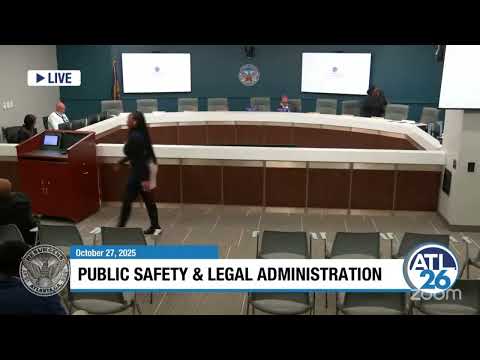
Daphne Talley, Director of the City of Atlanta Code Enforcement Section, told the Public Safety and Legal Administration Committee on Oct. 27 that the city currently fields 21 active code enforcement officers and has requested six more for calendar year 2026 to increase coverage in high‑call districts.
"For the past 2 years, we've had 25 code enforcement officers... So currently, we actually have 21 officers that are working in the field," Talley said, describing current staffing and vacancies caused by a resignation, one officer on injury and two on administrative leave.
Talley and Captain Baxter said the top five council districts account for roughly 75% of inspections in Quarters 1–3 and that about 90% of complaints are property‑maintenance violations (junk/debris, junk vehicles, scrap tires on private property and overgrowth) while roughly 10% are classified as highly hazardous (open/unsecured structures, raw sewage, unsanitary conditions and exposed wiring).
The code enforcement office has started to equip its officers with body‑worn cameras. "All of our code enforcement officers now are wearing body worn cameras," Captain Baxter told the committee, adding that camera footage can be used in court proceedings and supports evidence collection. The office also reported seven vehicles past service life and said it is working with procurement to replace fleet vehicles and to add a third demolition contractor.
Council members repeatedly raised the issue of scrap tires dumped on private property and asked what would happen when property owners do not remove tires. Talley said: "If the property owner does not remove the tires, then we will request those tires be removed either by the Department of Public Works or a city contractor."
Members also pressed code enforcement on covered and inoperable vehicles, and staff explained that a vehicle is considered a junk vehicle if it is not operable (for example, unable to be started and driven on a public street). Council members asked staff to coordinate with the Department of Public Works and with GDOT where underpass maintenance is the state’s responsibility; staff said they would refer underpass odor and related issues to GDOT and ATLDOT contacts.
What happened next: Staff said they are continuing recruitment for requested positions, working with the Vacancy Review Board and procurement on fleet and demolition contracts and coordinating with the solicitor’s office on enforcement and judicial procedures. Council members said they will pursue legislative and enforcement approaches to strengthen scrap‑tire compliance and to clear covered/inoperable vehicles from neighborhoods.