Get Full Government Meeting Transcripts, Videos, & Alerts Forever!
Get email alerts on the Dark Sky topic
No spam. Unsubscribe anytime.
Astronomers, students and municipalities back 'Dark Sky' bill to cut light pollution and save energy
Summary
Astronomers, students and municipal officials urged passage of S.2243/H.3494 to curb light pollution from publicly funded outdoor lighting and to require down‑shielded, appropriately colored fixtures with smart controls.
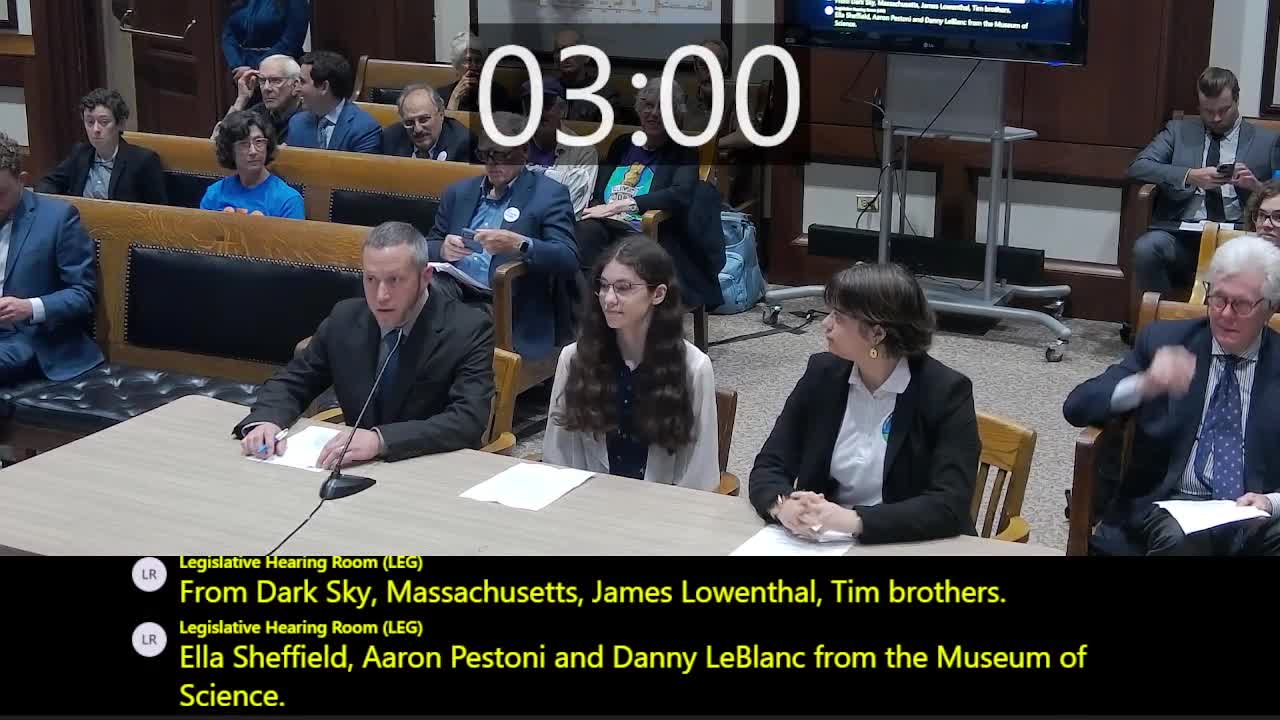
Tim Brothers of Dark Sky Massachusetts and student astronomers from MIT told the committee that public lighting regulations in S.2243/H.3494 would reduce skyglow, conserve energy and mitigate ecological and public‑health harms. "A key metric in determining energy waste as it relates to nighttime lighting is measuring the sky brightness or the sky glow," Brothers said, describing municipal projects in Westford and Pembroke that cut lighting energy consumption by roughly 50% and 81% respectively with shielded, warmer‑colored LEDs and smart dimming controls.
Student witnesses described how light pollution interferes with astronomical research and public education: "I fear what the sky may look like in a decade or two if light pollution continues to worsen," MIT student Erin Couson said. Museum and planetarium witnesses urged state leadership, saying changes are affordable and would not compromise public safety when fixtures follow Illuminating Engineering Society guidance.
The bill also asks the Department of Public Utilities to set new rates for unmetered lighting; proponents said utilities currently charge minimum wattage rates that result in overpayments for communities and that pricing reform would unlock additional municipal savings. Opponents were limited at this hearing; committee members raised concerns about nighttime safety and asked proponents to show how IES standards address pedestrian safety and glare.
Ending: Proponents requested favorable reporting and said state guidance would help towns adopt shielding, warmer color temperatures and smart controls to reduce energy use, save money and restore night sky visibility.