Get Full Government Meeting Transcripts, Videos, & Alerts Forever!
Get email alerts on the Drive Through Screening topic
No spam. Unsubscribe anytime.
Councilors consider requiring masonry walls plus landscaping when drive‑throughs face streets
Summary
As part of a broader zoning code update, planning staff proposed allowing drive‑through elements that face public streets only if developers add a masonry screen 3–4 feet high plus trees and shrubs to block headlights and queues; councilors asked about height flexibility, elevations and design treatments.
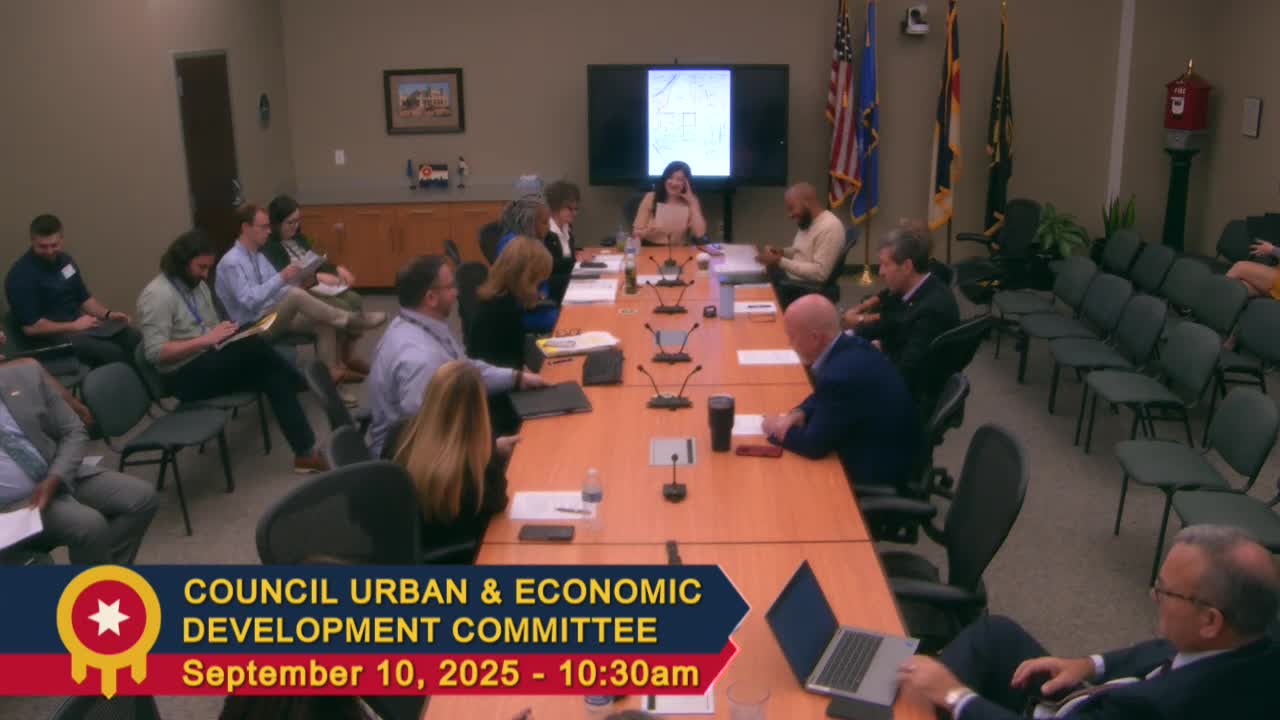
The committee considered a zoning-code amendment (ZCA 37) on Sept. 10 that would change how drive‑through facilities are treated when portions of the drive‑through aisle, ordering station or window face a public street.
Planning staff said the city currently disallows any part of a drive‑through facility to face streets, but variances have been granted in tight lots. Staff presented examples from other Oklahoma cities and nationwide and an analysis of headlight heights for commonly sold vehicles. To reduce impacts from queuing and vehicle headlights directed at the public right-of-way and adjacent residences, staff proposed permitting drive‑through elements that face the street only when the site includes an opaque masonry wall approximately 3 to 4 feet high plus trees and shrubs; the plants provide additional screening and the masonry element remains if landscaping does not survive.
Councilors asked whether the requirement should be a fixed 4 feet or a 3–4 foot range to allow design flexibility and to account for elevation differences, and they discussed undulating/wave-shaped wall designs, material requirements (masonry), maintenance questions and how the screening interacts with maximum headlight heights under state law (staff noted Oklahoma sets a 54‑inch maximum permitted headlight mounting height for vehicles). Staff said the combined wall and landscaping approach was the most effective way to preserve sightlines while reducing headlight glare and visual intrusion.
No committee action was recorded in the transcript; the proposal was discussed as part of the Title 42 zoning-code update.