Get Full Government Meeting Transcripts, Videos, & Alerts Forever!
Get email alerts on the Benefits Integrity topic
No spam. Unsubscribe anytime.
Oversight subcommittee warns of weak verification in assistance programs, cites high SNAP error rate and pandemic-era UIA fraud
Summary
Representative Wolford reported that Michigan relies heavily on self-attestation for benefits enrollment, cited a roughly 10% SNAP payment error rate and billions in pandemic-era unemployment fraud, and urged stronger front-end verification and technical fixes such as chip-enabled bridge cards.
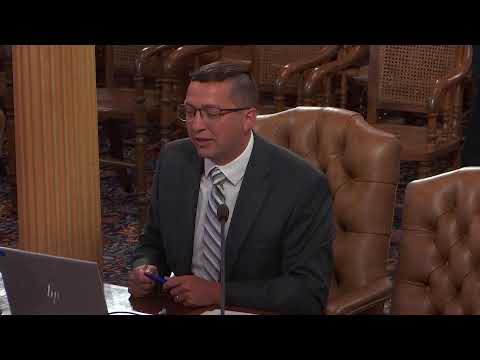
Representative Wolford, chair of the State and Local Public Assistance Program subcommittee, told the committee that hearings and reviews show Michigan relies extensively on self-attestation and post-approval phone interviews rather than front-end verification for benefit programs.
Wolford said the subcommittee examined the state benefits website and found enrollment could begin with minimal required information (first name, last name, address, and an alien number if noncitizen). He said federal rules do allow verification of Social Security numbers, residency, and identity and that the state has discretion to require additional checks, but that MDHHS has not exercised that authority consistently.
Wolford cited a SNAP payment error rate under Governor Whitmer of about 10%, compared with a national average near 6%, and warned that under federal rules the state could face roughly $300 million in penalties next year if error rates are not improved. He also reiterated figures the subcommittee discussed for pandemic unemployment fraud—"over $10 billion and counting"—and described examples of large-scale identity-fraud operations using stolen card data.
Recommendations discussed during Q&A included eliminating reliance on self-attestation, requiring verification of SSNs, identity and residency, and considering chip-enabled bridge cards to reduce card fraud. Wolford said the state OIG estimated at least $200 million annual waste that could be prevented by moving to chip cards, and that those changes, combined with enforcement, could materially reduce losses. Members asked for a fiscal analysis of chip cards and the administrative costs of stricter verification.
Wolford said the subcommittee’s work is informational at present and that future policy moves would be considered after further analysis and input from members.