Get Full Government Meeting Transcripts, Videos, & Alerts Forever!
Get email alerts on the Public Safety topic
No spam. Unsubscribe anytime.
San Marcos upgrades outdoor siren system to auto-activate on NWS warnings; staff urges outreach as coverage gaps remain
Summary
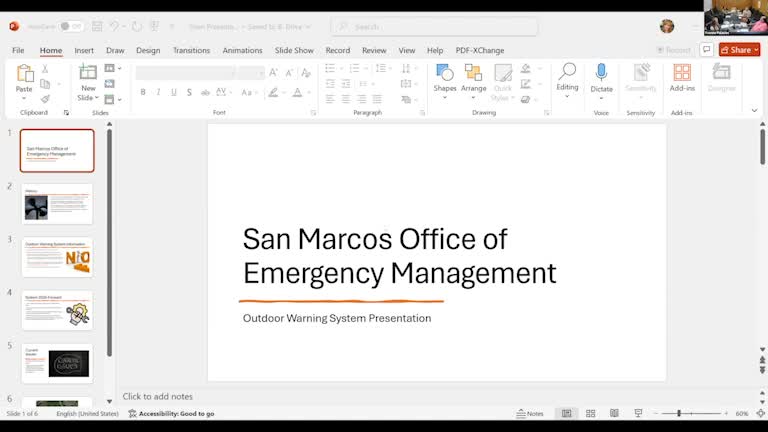
San Marcos officials said they repaired an aging 14-tower siren network and upgraded it to auto-activate when the National Weather Service issues tornado or flash-flood warnings for Hays County.
Reese Martin, assistant emergency management coordinator, told the Neighborhood Commission the city—s outdoor warning siren system consists of 14 towers installed in 2011–2013 with hazard-mitigation grant funds for disaster 1780. He said many towers had fallen into disrepair and were repaired after he was hired in 2020.
Martin described four siren patterns the system can produce: a tornado pattern (repeated steady high tone cycles for 2–3 minutes), a wildland-fire pattern (15-second steady highs separated by lulls, repeated for 2–3 minutes), a general all-hazards pattern (10-second cycles), and a monthly low test (first Saturday of each month at noon).
He said the system was upgraded to include software that monitors National Weather Service (NWS) bulletins; the software can automatically activate the tornado pattern and the all-hazards/flash-flood pattern when the NWS issues a warning for Hays County. Martin said the contractor for maintenance and software is American Signal Corp and that the city has a maintenance contract to support the system.
Martin cautioned that the sirens are designed primarily for people outdoors; many neighborhoods now fall outside reliable audible coverage because the city—s population footprint has grown since the towers were placed. He said most towers are grid-powered with limited battery backup (one site is solar); newer towers could include solar-plus-battery, but replacements are costly. He said sirens communicate via VHF radio.
Commissioners and residents asked about outreach and identifying which tower corresponds to which neighborhood. Martin said the city posted audio samples and a zone map online and has a contractor-produced zone coverage map; he asked staff to produce a clearer street-level map and said he would work with utilities on a mailed outreach effort. Commissioners suggested QR codes on signs or mailers that play the exact recorded tones.
Martin said if residents hear the sirens outdoors they should get off the river and seek shelter, then check authoritative information sources such as NWS products and the city—s alert channels.