Get Full Government Meeting Transcripts, Videos, & Alerts Forever!
Get email alerts on the Zoning topic
No spam. Unsubscribe anytime.
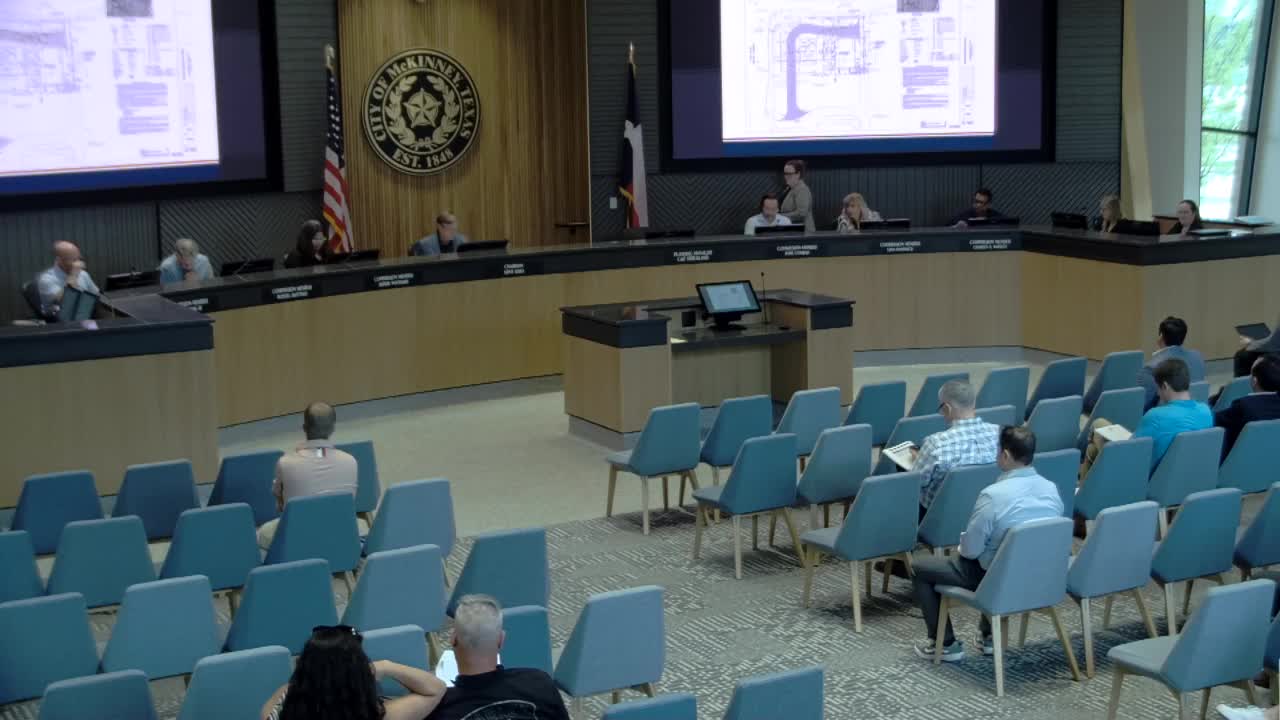
McKinney planners deny proposed mixed‑use rezoning on North Tennessee after residents press parking, buffering concerns
Summary
The McKinney Planning & Zoning Commission voted 5–2 on Aug. 12 to deny a developer’s request to rezone a downtown parcel on North Tennessee Street for multifamily and ground‑floor retail, after neighbors and commissioners raised questions about parking, buffering and neighborhood compatibility.
The McKinney Planning & Zoning Commission denied a rezoning request for a proposed mixed‑use development on a block bounded by North Tennessee Street and East Hertz Street, voting 5–2 on Aug. 12 to send the denial to City Council for final action on Aug. 19.
Planner Araceli Motteo told the commission the applicant had revised the proposal after earlier feedback, lowering the maximum unit count from 90 to 79, adjusting parking from a standard 1.75 spaces per multifamily unit toward 1.17 spaces per unit, and replacing an initially proposed metal fence with a living screen of Leyland cypress planted at roughly one tree per 5 feet along the residential edge. Motteo said staff had received multiple letters of support and opposition and recommended approval of the rezoning request.
Developer Jason Rose described a design that concentrates parking to the rear and places ground‑floor micro retail at the Tennessee Street frontage to create a walkable streetscape. Rose said he had made concessions in response to neighbors, including moving a dumpster and reducing density, and he described plans for planter irrigation and maintenance. "I would get rid of all the commercial," Rose said when pressed later in the meeting, but added that providing the street‑level retail was central to the character he sought for Tennessee Street.
Residents who live on North Kentucky and adjacent streets opposed the rezoning or urged further concessions. Adam Stewart, a neighbor who led an outreach effort, said the neighborhood remained "fairly concerned about the parking" and noted a petition with multiple signatures. William Kent and Joseph Collins told commissioners they feared spillover parking, more traffic on narrow residential streets and drainage problems. Joseph Collins said recent storms already produce hazardous flooding at the intersection of North Tennessee and Heard Street. A few speakers favored the project’s potential to attract younger residents and small businesses, but the public testimony was dominated by concerns over parking, curb access and neighborhood impacts.
Commissioners debated whether the proposal had gone far enough to address neighbor concerns. One commissioner said pausing earlier to encourage more negotiation had not produced a compromise and that the parties were still "further apart than we are being." Commissioners pressed the developer about alternatives, including removing the commercial component, assigning resident parking spaces, and pursuing off‑site parking agreements; the developer said he had limited flexibility without changing the project's financial viability.
On final action the commission first failed a motion to approve the rezoning (vote 4–3). After a subsequent motion to deny, the commission approved denial 5–2. The commission record shows the denial will be forwarded to City Council for final action on Aug. 19, 2025.
Why this matters: The site sits at the edge of McKinney’s historic downtown neighborhoods; decisions about density, parking ratios and screening set precedent for how redevelopment interfaces with long‑established single‑family blocks. The meeting record shows residents pressed for concrete protections — parking controls, curb‑access planning, and preserved tree buffers — that generally would be handled at site‑plan or special‑use stages if the rezoning were approved.
Next steps: The denial will be forwarded to City Council, which will take the final vote on Aug. 19. If the council declines to overturn the commission, the applicant may revise and resubmit or pursue appeals in accordance with city procedures.
Sources: Planner Araceli Motteo and applicant Jason Rose presented the proposal to the commission; public testimony from Adam Stewart, William Kent, Joseph Collins, Andrew Arrington and others is recorded in the meeting transcript. The transcript indicates the proposal included a reduction to 79 units, a proposed 1.17 parking ratio, and a proposed living screen of Leyland cypress at one per 5 feet along the residential edge.