Get Full Government Meeting Transcripts, Videos, & Alerts Forever!
Get email alerts on the City Finance topic
No spam. Unsubscribe anytime.
Ione finance manager warns revenue decline, cites interfund borrowing and $11 million of debt
Summary
Finance Manager Michael told the Island City Council that the city’s total revenue peaked and has been trending downward for about 2–3 years, while expenses have edged up. Michael said reserves and interfund borrowing present risks and urged the council to focus on revenue-generation rather than additional internal bureaucracy.
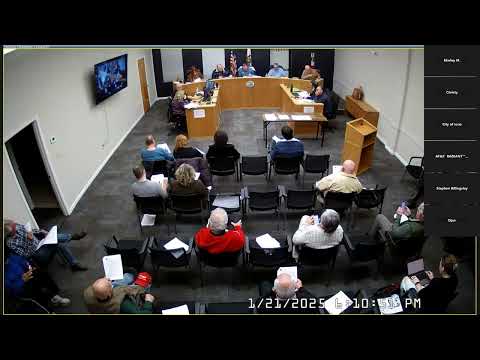
Finance manager Michael presented a multi-slide report to the Island City Council on Jan. 21, saying the city’s total revenues have peaked and are now trending downward while expenses continue to grow, producing a multiyear budget gap.
"We are going revenue downward," Michael said, pointing to a chart that showed revenue peaks tied to one-time developer fees and COVID-related funds. He told the council that the only reliable way to reverse the trend is more revenue: "The only way you're really gonna pull out of this is a change to revenue."
The presentation showed the city’s general-fund expenses have risen about 7.14% over five years while cumulative inflation over that span was cited at roughly 21.14%, a gap the finance manager framed as a pressure on the city’s purchasing power. Michael said some of the city’s interest income and better reserve management produced a small uptick in net results, but overall the trend remains negative.
Council members questioned Michael about outstanding liabilities. He said total debt exceeds current reserves and noted that interfund borrowing—departments loaning money to each other—appeared to be about $3,000,000 in unpaid balances cited in the city’s 2020 audit, and that, if left unaddressed, the city could be ‘‘upside down’’ over time. Michael emphasized that most obligations are not immediately due but that the city must address cash flow and repayment in upcoming budget workshops.
Council and members of the public responded with suggestions and concerns. Michael and others discussed options to boost revenue, including attracting retail to increase sales-tax receipts, promoting development that couples housing with commercial retail, and, as a short-term tactic used elsewhere, modest retail-tax rate changes. Several public commenters said downtown lacks parking and retail demand, arguing that increasing retail requires infrastructure and visitor demand that Ione may not have.
The council did not take formal action on Michael’s report. Members directed staff to use workshop time to produce firmer figures on interfund loan balances and to develop approaches for reversing the revenue decline discussed in the presentation.
The presentation and subsequent Q&A were lengthy and repeatedly returned to three points: revenues are down versus historical one-time inflows, reserves are at risk if the trend continues, and policy changes that increase bureaucracy will not substitute for new revenue sources.