Get Full Government Meeting Transcripts, Videos, & Alerts Forever!
Get email alerts on the Wolf Hunting Season topic
No spam. Unsubscribe anytime.
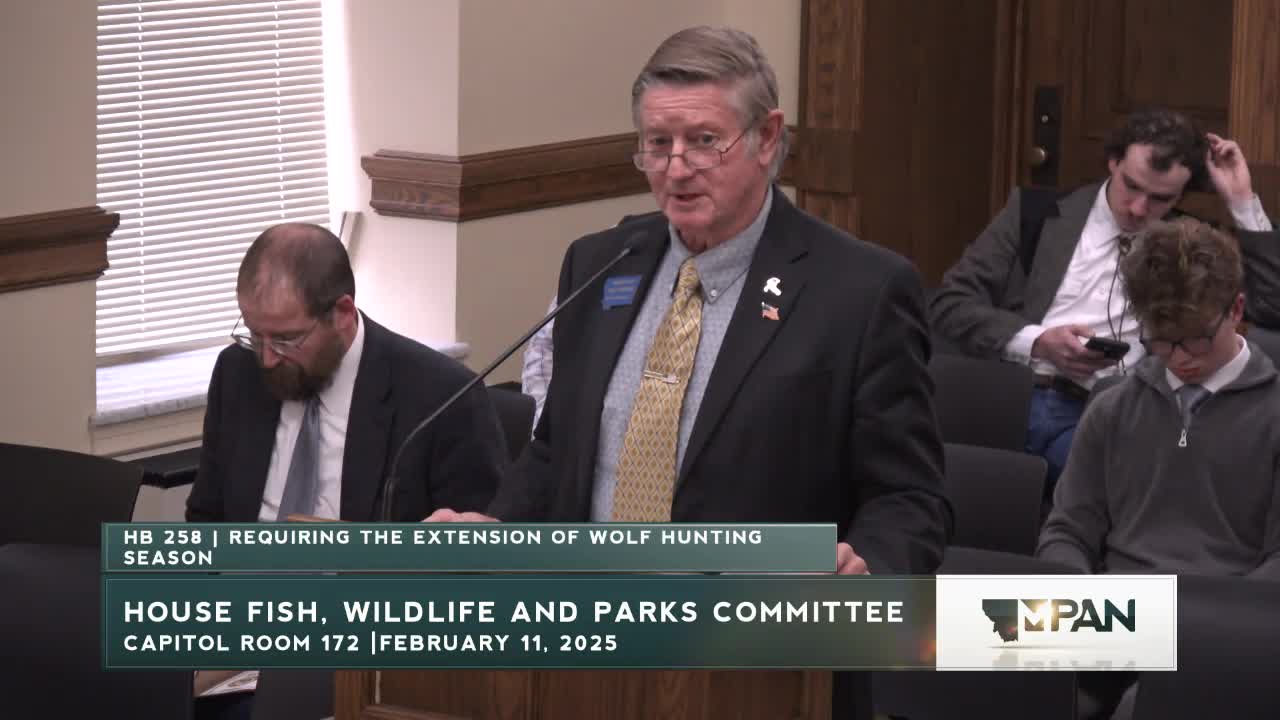
Committee hears HB 258 to extend wolf hunting season into spring; Fish and Wildlife staff warn of model risks
Summary
Representative Paul Fielder presented HB 258 to extend the wolf hunting season to close concurrent with the spring black‑bear season; proponents said the extension offsets reduced trapping opportunity, while opponents warned of pup mortality, pack destabilization and risks to monitoring models.
The House Fish, Wildlife and Parks Committee heard more than three hours of testimony on House Bill 258, which would require the Fish, Wildlife and Parks Commission to authorize a wolf hunting season that closes in concurrence with the state spring black‑bear season (sponsor Representative Paul Fielder). Proponents argued the shorter trapping season imposed by recent federal court decisions has reduced the state’s ability to control wolf numbers and that extending the hunting season would provide additional harvest opportunity.
Proponents included representatives of hunting and trapping organizations (Jeff Darrah, Montana Sportsmen for Fish and Wildlife; Chris Morgan, Montana Trappers Association), Outdoor Heritage Coalition leadership and ranchers who said extended hunting is a legal tool and would improve managers’ ability to reduce wolf numbers where the department has been directed to do so. Proponents cited the 2003 Montana wolf management plan and federal recovery numbers as a rationale for targeted harvest; several speakers argued harvest during spring can be regulated to avoid direct pup take.
Opponents included tribal representatives, conservation groups, tourism and wildlife organizations, and many members of the public who said the bill would allow hunting during denning and whelping, create direct and indirect mortality of pups, destabilize packs, and harm tourism and local economies that benefit from wolf viewing. Mark Cook (Wolves and Rockies) cautioned that the change would permit “the slaughter of female wolves who may be carrying offspring, nursing wolf cubs, and even the killing of wolf cubs in the safety of their dens” (Mark Cook, Wolves and Rockies; testimony at 5514.705). Tribal leaders, the Montana Wildlife Federation and other groups urged a do‑not‑pass recommendation.
Quentin Kujala (FWP Chief of Conservation Policy) appeared as an informational witness and said FWP opposes HB 258; he described ways the proposed extension could produce undocumented pup mortality that would reduce the short‑term accuracy of the state’s population model (IPAM) and affect the department’s ability to show sustained recovery in federal reviews. Kujala referenced the department’s analysis of IPAM and the risk that large, sudden changes in harvest patterns would require multi‑year adjustments to monitoring models. He also cited a 2010 comparative study and federal delisting documents describing breeding‑pair and total‑wolf thresholds relevant to recovery decisions.
Key numbers discussed in testimony and department materials: the 2003 state wolf management plan cited 15 breeding pairs and 282 wolves as a minimum target for state management; the US Fish and Wildlife Service’s Northern Rockies recovery documentation referenced 30 breeding pairs and 300 wolves in the region; witnesses and department staff also noted recent IPAM‑derived population estimates for Montana in the mid‑hundreds to low thousands depending on the year and methodology.
No committee vote was recorded on HB 258 at this meeting; the hearing closed after extensive testimony and committee questioning.