Get Full Government Meeting Transcripts, Videos, & Alerts Forever!
Get email alerts on the Hunter Orange topic
No spam. Unsubscribe anytime.
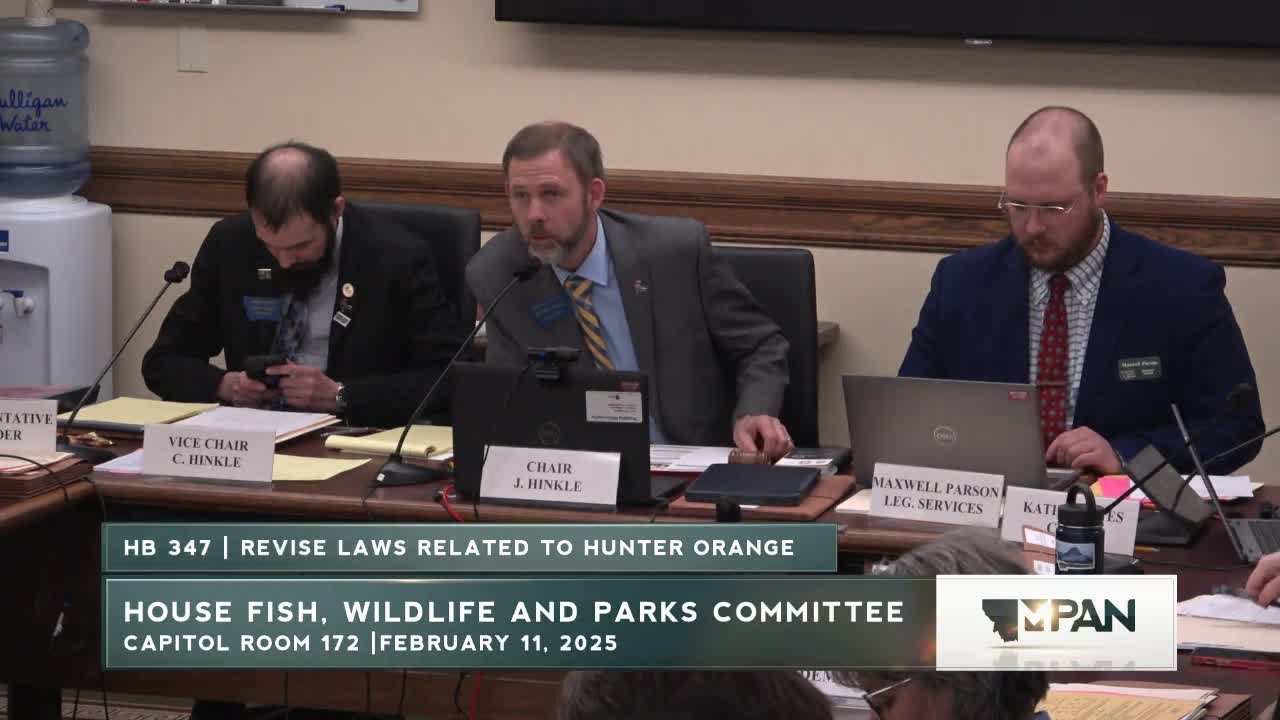
Committee hears HB 347 to move hunter-orange standard to Fish, Wildlife and Parks commission
Summary
The House Fish, Wildlife and Parks Committee heard testimony on House Bill 347, which would repeal Montana’s statutory 400‑square‑inch hunter‑orange requirement and give the Fish, Wildlife and Parks Commission authority to set visibility rules.
The House Fish, Wildlife and Parks Committee heard testimony on House Bill 347, sponsored by Representative Gary Perry, which would repeal the statutory 400‑square‑inch hunter‑orange requirement and give the Fish, Wildlife and Parks Commission authority to set hunter‑visibility rules.
Proponents including Rob Arnaud, executive director of the Montana Conservation Society, told the committee the change would let the commission develop species‑specific and season‑specific rules and increase public input into regulation. “Hunter orange isn’t the issue of the bill,” Arnaud said, adding that the bill is intended to “modernize how Montana manages Hunter Orange” (Rob Arnaud, Executive Director, Montana Conservation Society; first spoken at 477.35). Other proponents — hunters, former wardens and outfitting guides — said the statutory requirement is blunt and sometimes impractical for single‑person mountain hunts (Jim Loessberg; Mark Anderson; Dan Lewis; testimony at 630.49, 786.34503, 871.735).
Opponents including retired hunter‑education instructor Wade Cooperrider and Orange Aglow owner David Clumpner said the 400‑square‑inch rule has been linked historically to reductions in mistaken‑for‑game incidents and that removing a clear statutory minimum could increase confusion for new hunters and the public. “The most effective color out there to be seen” and the historical drop in mistaken‑for‑game incidents after orange became mandatory were cited by Cooperrider (Wade Cooperrider, retired FWP hunter‑education instructor; testimony at 1078.4299). Industry witnesses described local businesses that manufacture blaze‑orange gear and warned of economic harm if the requirement is loosened (David Clumpner, Orange Aglow; testimony at 1301.4601).
Quentin Kujala, Chief of Conservation Policy for FWP, appeared as an informational witness and addressed technical questions on what FWP has reviewed about other states’ approaches and on the department’s capacity to administer species‑specific rules (Quentin Kujala, Chief of Conservation Policy, FWP; informational at 1894.12). Committee members asked about human visual perception and species‑specific vision, the possibility that the commission could retain the 400‑square‑inch standard, and whether the bill would permit the commission to require nonhunters to wear orange in certain circumstances; the sponsor said the bill “doesn’t say you can’t wear orange” and that it places decision making at the commission so it can adapt rules by season and species (Representative Gary Perry; closing remarks at 2969.36).
No formal action was taken on HB 347 during this meeting; it was discussed at length and the hearing closed without a committee vote.
Clarifying details from testimony: the current statutory requirement cited in the hearing is 400 square inches of hunter‑orange material above the waist during firearm seasons; witnesses identified examples of other states’ approaches (Arizona, Nevada, Alaska and Texas among those with limited or no orange requirements) and said some states use different minimums (e.g., Colorado and Utah require 500 square inches plus a hat). FWP staff referenced a 2010 Oregon review of four states that found moving to hunter orange reduced incidents per 100,000 hunters by an average 22% and reduced fatalities by 40% in that sample (Quentin Kujala, informational testimony at 2399.2852).
The committee record shows substantial disagreement: proponents want flexibility and species/season nuance; opponents want a clear statutory floor and point to a safety record they attribute to the existing rule. The department stood by its role as an informational witness and noted potential impacts to monitoring if regulations change quickly.
Provenance: topics introduced and closed in committee hearing transcripts starting at 316.95 and finishing at 3050.53.