Get Full Government Meeting Transcripts, Videos, & Alerts Forever!
Get email alerts on the Code Enforcement topic
No spam. Unsubscribe anytime.
Council defers overhaul of nuisance‑abatement code after extensive public comment and amendments
Summary
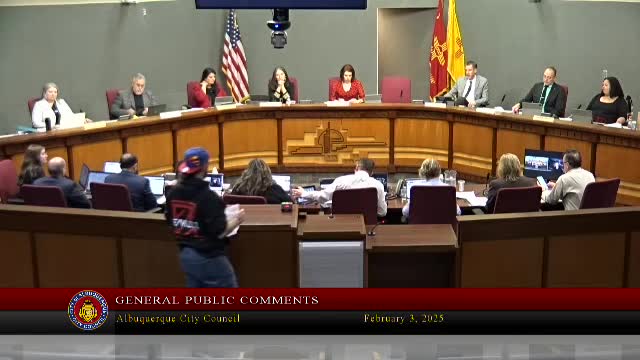
After hours of public testimony and multiple floor amendments on Feb. 3, the Albuquerque City Council voted unanimously to defer consideration of Ordinance 063, a proposed repeal and replacement of the city’s nuisance‑abatement code, for 30 days to allow additional revisions. Public commenters and several councilors raised concerns about broad
The Albuquerque City Council on Feb. 3 deferred action for 30 days on a proposed, comprehensive rewrite of the city’s nuisance‑abatement ordinance (0‑63) after prolonged public testimony, expert and staff presentations, and numerous floor amendments.
What the proposal would have done: The draft ordinance repealed existing nuisance provisions and proposed a consolidated framework for declaring and abating public nuisances (including noise, weed/litter, animal and fire code issues). It also added an administrative enforcement path — an independent hearing‑officer process — in addition to existing court remedies, and restructured civil‑fine authority with higher maximum daily fines for certain violations.
Major concerns raised: Public testimony and several councilors said the draft’s definitions are too broad and could be used to penalize vulnerable people, small businesses, faith groups and organizations that provide services to people experiencing homelessness. Several commenters and councilors argued the ordinance could have disproportionate impacts on survivors of domestic violence (because repeated police calls could trigger administrative penalties) and could be weaponized by rivals or adversaries to shut down businesses. Councilors pressed staff on due‑process safeguards, the independent hearing‑officer appointment process, protections for domestic‑violence survivors, fine‑structure fairness and whether camping or storage of personal property on private land could be treated as a nuisance.
Amendments and outcome: Council considered multiple floor amendments (some passed and some failed) that adjusted fine structures, added procedural protections and clarified language. After debate and multiple votes on floor amendments, council voted unanimously to defer the ordinance for 30 days to allow staff and councilors to craft revisions — particularly protections for survivors, clearer thresholds for nuisance designations, and procedural guarantees for hearings.
Why it matters: The ordinance rewrites how the city might declare and abate nuisance properties and would change the balance between administrative enforcement and judicial remedies. Critics warned it could unintentionally criminalize poverty and amplify displacement risks; supporters said stronger remedies are needed for persistent public‑safety hazards. The deferral reflects the council’s decision to seek more work and public input before final action.
Speakers quoted: City Attorney staff and counsel summarized the legal concerns and explained the administrative hearing option; many public commenters urged a no vote, citing impacts on homelessness and small businesses. Councilor Grout (sponsor) asked for the 30‑day deferral to allow amendments and more outreach.