Get Full Government Meeting Transcripts, Videos, & Alerts Forever!
Get email alerts on the Zoning topic
No spam. Unsubscribe anytime.
Council overturns ZHE denial, allows electronic sign at Faith Lutheran with conditions
Summary
The City Council on Feb. 3 overturned the Zoning Hearing Examiner’s denial and approved a variance to allow an illuminated electronic sign for Faith Lutheran Church that would be visible from a nearby residential zone, subject to conditions including nighttime dim/off hours and compliance with IDO sign rules.
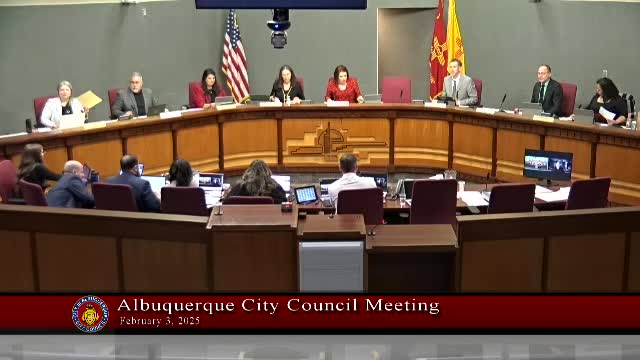
On Feb. 3 the Albuquerque City Council granted an appeal by Faith Lutheran Church to replace an existing non‑conforming reader‑board sign with a new illuminated electronic sign that would be visible from a residential zone across the street.
Background: Under the Integrated Development Ordinance (IDO), illuminated or electronic signs are prohibited within 200 feet of a residential zone when visible from that residential area unless a variance is approved. The Zoning Hearing Examiner had denied the church’s variance, finding adverse light impacts on adjacent residential properties. The church appealed that denial to council.
LUHO recommendation and conditions: The Council’s land‑use hearing officer (LUHO) recommended reversing the ZHE denial, finding evidence that the new sign would reduce adverse impacts because it is dimmable, emits less continuous light, can be turned off, and can be controlled electronically. LUHO recommended approval subject to two conditions the church accepted: (1) the sign must be turned off daily between 10 p.m. and 6 a.m., except for Christmas Eve and the week of Holy Week; and (2) the sign must comply with IDO electronic‑sign technical standards on placement, transitions and related rules.
Council action: Following public comment and council discussion, the council accepted LUHO’s recommendation and granted the appeal by an 8–1 vote. Council members discussed the difference between older reader‑board signs and modern electronic signs, emphasizing dimming controls and off‑hours as means to mitigate light pollution.
Why it matters: The decision allows a non‑conforming church sign to be replaced with a modern electronic display under specific limits, and sets a local precedent for how dimmable electronic signs and off‑hours can address neighborhood light‑impact concerns.
Provenance: The discussion and appeal records were presented by planning staff; LUHO findings and the church’s agreement to conditions were part of the record.
Speakers quoted: Planning staff summarized LUHO findings; a councilor summarized that the modern electronic sign “can be updated electronically, it emits less light and it's dimmable.”