
City economist: corrected gross‑receipts growth about 2% for November; FY25 budget baseline reiterated
Get AI-powered insights, summaries, and transcripts
Subscribe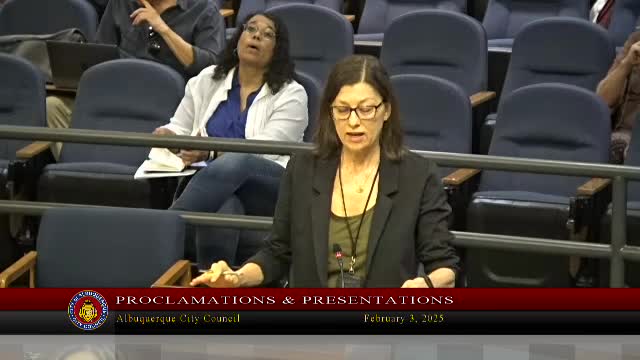
Summary
City Economist Christine Berner reported to the City Council on Feb. 3 that November 2024 gross receipts tax (GRT) receipts declined year‑over‑year because the City received a one‑time amended hold‑harmless payment in the prior year; when corrected, underlying growth is about 2% for the month and roughly 4% year‑to‑date. Berner reviewed sectoral
Christine Berner, the City of Albuquerque economist, briefed the City Council on Feb. 3 on gross‑receipts tax (GRT) collections for November 2024 (received by the city in January 2025).
Berner explained that December year‑over‑year comparisons looked weak because the city in the prior November had received a one‑time, amended hold‑harmless payment of approximately $5.2 million tied to food tax reporting corrections by a business. When that lump sum is excluded from the prior‑year total, the underlying economic growth signal for November 2024 is about 2% for the month and roughly 4% year‑to‑date. She reiterated that the FY25 budget assumed about 2.1% growth over the previous year.
Sector details: Berner spelled out sector performance in the shared 1 percent GRT allocation — health care and information (film industry) showed positive contributions, while construction and business‑support sectors showed declines in the month. She also noted that tax increment district (TID) transfers reduce local GRT available for the city and that FY24 TID transfers were elevated (roughly $5.7 million) largely because of a Netflix‑area expansion at Mesa del Sol.
Councilors asked for additional detail on sector and TID effects; Berner and staff agreed to supply follow‑up detail on some questions about construction and TID timing.
Why it matters: GRT is a primary city revenue source for the operating budget; corrections to the series and an understanding of TID transfers matter for near‑term budget projections and upcoming budget deliberations.
Speakers quoted: Christine Berner said, “When I correct for that lump sum, the growth appears to be around 2% for us for this month,” and noted that excluding TID impacts would raise year‑to‑date growth estimates.